8.9 Beta-2 Adrenergic Agonists
Bronchodilators are widely used for symptomatic relief of bronchospasm related to asthma or chronic obstructive respiratory disease (COPD). Beta-2 adrenergic agonists are the most commonly used bronchodilator for both quick acting relief and long-term management. Other bronchodilators are anticholinergics, methylxanthines as well as combination inhalers. These will be reviewed in the upcoming units.
Before you begin this unit and the subsequent units, take time to review asthma and COPD in unit 8.1, in particular the management of both diseases. A brief overview is provided below. This unit does not address the many non-pharmacological interventions that are necessary.
Asthma medication management
Following a diagnosis, the treatment of asthma has two goals: terminate bronchospasm during an acute attack and to reduce or prevent risk (preventing reoccurrence, preventing further airway damage). This is accomplished by using a combination of medications.
- Beta adrenergic agonists and anticholinergics: bronchodilators
- Inhaled corticosteroids: suppress inflammation
COPD medication management
COPD is a chronic, progressive disease. According to the Canadian Thoracic Society, the treatment goals are to reduce dyspnea, improve health status, prevent acute exacerbations and reduce mortality (Bourbeau et al, 2023). Treatment depends on the severity (mild, moderate, severe). This is accomplished by using a combination of medications:
- Beta adrenergic agonists and anticholinergics: bronchodilators, short and long acting
- Inhaled corticosteroids: suppress inflammation
- Phosphodiesterase type 4 inhibitors
In this unit, we will review beta adrenergic agonists: Salbutamol (short acting) and salmeterol (long acting).
See the “Autonomic Nervous System: Beta-2 Agonists” chapter for more information regarding Beta-2 agonists.
Beta Adrenergic Receptor Agonists: salbutamol and salmeterol
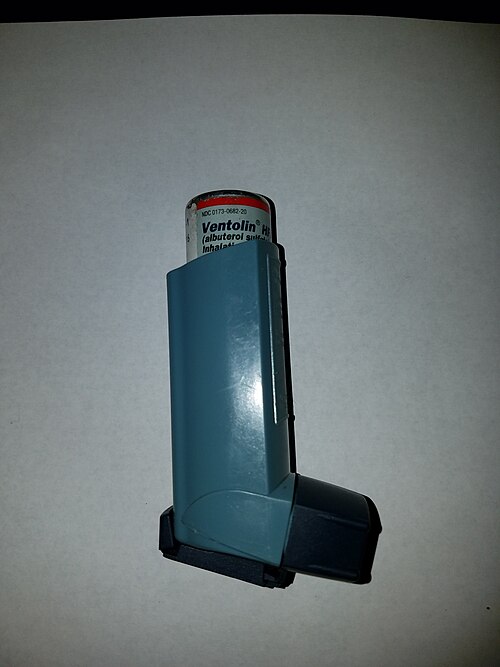
Salbutamol is the most widely used bronchodilator for effective relief of acute bronchospasm. It is considered a ‘rescue’ or ‘reliever’ inhaler that reverses airway narrowing. Note that in the U.S, it is called albuterol.
Salmeterol is the long-acting bronchodilator and as the name suggests, it has a long duration of action. Note that other formulations are often prescribed that are combination inhalers, for example, the ICS-formoterol inhaler.
Mechanism of Action
Salbutamol and salmeterol stimulate Beta 2-adrenergic receptors in the smooth muscle of bronchi and bronchioles producing bronchodilation. The lungs have a large number of beta-2 receptors. The binding increases the formation of intracellular cAMP by stimulation of adenylyl cyclase which results in relaxing airway smooth muscle, inhibits the release of histamine from mast cells, inhibits macrovascular leakage and to a small degree it increases mucociliary transport (Daily Med, 2025; Vallerand & Sanoski, 2024). In simpler terms, beta-2 receptor stimulation increases cAMP, resulting in smooth muscle relaxation and bronchodilation.
Indications for Use
Short-acting beta agonists (SABA) is used to prevent an acute attack with onset of action almost immediately. They provide rapid relief of acute bronchospasm and prevent exercise-induced bronchospasm. They treat bronchospasms to prevent wheezing, chest tightness and difficulty breathing due to respiratory diseases such as asthma and COPD.
Long-acting beta agonists (LABA), salmeterol, is used to prevent bronchospasm. LABA are both inhaled and oral formulas. Terbutaline is an example of an oral LABA although less commonly prescribed. It is taken up to four times a day. It is also available in an inhaled form.
Salbutamol can also be used for hyperkalemia. It causes hypokalemia as a result of an influx of potassium into skeletal muscle cells.
Nursing Considerations
Administration: short acting salbutamol: inhaled route. Long-acting salmeterol is inhaled or oral route.
Short Acting Beta Agonist (SABA):
- Onset 5-15 minutes, with a duration 3-6 hours. 1-2 puffs q 20min x 3 doses for acute exacerbation.
- MDI, DPI or nebulizer
- Hydrophilic, so not stored in tissues
Long-Acting Beta Agonist (LABA):
- Fixed schedule dosing i.e. BID
- It is lipophilic so longer duration of action.
- Onset 10-15 minutes with duration up to 12 hours
Safety Alert
Do not confuse the two beta-2 adrenergic inhalers. Salbutamol is short-acting and used for acute bronchospasm or anticipated exercise-induced bronchoconstriction. It is considered a rescue medication.
Salmeterol is long-acting and used for maintenance therapy for clients with asthma or COPD.
Monitoring:
- Assess lung sounds and respiratory rate before therapy. Assess for wheezes, work of breathing, oxygen saturations and stridor.
- Assess pulse and BP
- Assess sputum for colour and consistency
Prior to dosing: prime inhaler first by releasing four test sprays into the air.
Pediatric dosing: deliver by metered dose inhaler with a spacer device.
Pregnancy: avoid with pregnancy unless benefits outweigh risks. Do not use during labour due to interfering with uterine contractions.
(Vallerand & Sanoski, 2024)
Adverse/Side Effects
Side effects are related to sympathomimetic action. Anxiety, insomnia, tachycardia and tremor. Usually transient and mild.
Long term over use can lead to hypokalemia and hyperglycemia (stimulates hepatic glucose production).
Beta-2 agonists can cause muscle tremor, excessive cardiac stimulation, and CNS stimulation (Frandsen & Pennington, 2018).
Inhalation administration
The inhalation route has many advantages over other routes. It delivers the drug directly to the lungs or site of action, systemic effects are minimized, the relief of attacks is rapid. There are four types of inhalation devices: metered dose (pressurized device that delivers a measured dose), Respimat (fine mist), dry powder inhaler (dry micronized powder) and nebulizer (converts drug solution into a mist). The most common type is the metered dose (MDI). For any of these devices, correct use is important so the medication reaches the lungs. For example, a spacer is usually recommended for a MDI inhaler so the med does not end up in the mouth instead of the lungs. For more information: Delivery Devices – Asthma Canada (Asthma.ca, 2026).
Client Teaching
- Instruct clients to take medications as directed and report to their healthcare provider any sustained or worsening symptoms.
- When first using an inhaler, clients should be instructed to prime the inhaler unit prior to administering their medication and as per manufacturers recommendations.
- Ensure client understands correct inhaler technique, use of spacing devices and to seek medical care if rescue med is not relieving symptoms.
- Use of medications like salbutamol can cause an unusual taste in the mouth, and rinsing the mouth with water after use is permitted.
- Clients should have an understanding of medication onset and use short-acting and long-acting inhalers appropriately.
- Notify the prescriber if pregnant or planning on becoming pregnant.
Salbutamol and Salmeterol Medication Card
Now let’s take a closer look at the medication card for salbutamol and salmeterol (Adams et al, 2020; Frandsen & Pennington, 2018; Vallerand & Sanoski, 2024).

Downloadable file (.docx): Salbutamol and Salmeterol Medication Card
The following Chapter 8 Comparing Respiratory Medications med cards is also an option to support your learning. Download and edit as needed.
Critical Thinking and Decision-Making Questions
Complete the following questions to test your understanding. Go to the chapter 8.9 answer key
- A 30-year-old client presents to the ED with acute SOB and bronchospasm. She informs the nurse she has asthma and ran out of her inhaler, Salbutamol.
- The nurse quickly does a respiratory assessment. Besides SOB, what might be other cues of bronchospasm?
- The nurse prepares to give salbutamol. What is important to do prior to giving the med?
- The client’s condition has improved. She tells the nurse she sometimes takes her salbutamol 2 puffs at a time, up to 4 times in a day. What is the concern with this administration?
- Which statements are correct about beta 2 adrenergic agonist inhalers? Select all that apply
- Short acting beta 2 adrenergic agonist inhalers are used for acute bronchospasm.
- If a beta 2 adrenergic agonist inhaler is used prior to exercise, take the inhaler one hour prior to exercise.
- These meds may cause temporary tachycardia and tremor which can be severe and lead to long term effects. If this occurs, report to the prescriber.
- It is safe to use salbutamol if a client is pregnant.
- True or False: Salmeterol is used for acute bronchospasm.
Note: Answers to the Clinical Reasoning Activities and Critical Thinking questions can be found in the Chapter 8: Respiratory Medications Answer Key V2 – Fundamentals of Nursing Pharmacology – 2nd Canadian Edition section at the end of the book.
References
“Ventolin® HFA (Albuterol Sulfate) Inhaler.jpg” by MisterNarwhal is licensed under CC BY SA 4.0 ↵
“Albuterol 2.jpg” by Mark Oniffrey is licensed under CC BY SA 4.0 ↵
Adams, M., Holland, N., & Urban, C. (2020). Pharmacology for nurses: A pathophysiologic approach (6th ed.). pp. 622-63 & 626. Pearson. ↵
Asthma.ca (2026). Delivery Devices. Delivery Devices – Asthma Canada
Daily Med (2025). Albuterol. https://dailymed.nlm.nih.gov/dailymed/drugInfo.cfm?setid=a000abb9-92a1-4c84-8932-cd40c476dc00
Frandsen, G. & Pennington, S. (2018). Abrams’ clinical drug: Rationales for nursing practice (11th ed.). Wolters Kluwer.
Vallerand, A. & Sanoski, C. (2024). Davis’s Canadian drug guide for nurses (19th ed.). F.A. Davis Company: Canada
Velarde, G. (2020). Pharmacology Notes: Nursing Implications for Clinical Practice licenced under CC BY-NC-SA 4.0. ↵