12.15 Antivirals

Unlike the complex structure of fungi or protozoa, viral structure is simple. There are several subclasses of antiviral medications: antiherpes, antiinfluenza, anti-hepatitis, and antiretrovirals. Each subclass will be discussed in more detail below. See Figure 12.15a[1] for images of viruses.
Subclass: Antiherpes
Indications for Use: Acyclovir (Zovirax) and its derivatives are frequently used for the treatment of herpes and varicella virus infections, including genital herpes, chickenpox, shingles, Epstein-Barr virus infections, and cytomegalovirus infections.
Mechanism of Action: Acyclovir causes termination of the DNA chain during the viral replication process. Acyclovir can be administered either topically or systemically, depending on the infection.[2]
Special Administration Considerations: Acyclovir use may result in nephrotoxicity.
Client Teaching & Education: Clients who are being treated with antiviral therapy should be instructed about the importance of medication compliance. They may also experience significant fatigue, so periods of rest should be encouraged.[3]
Subclass: AntiInfluenza
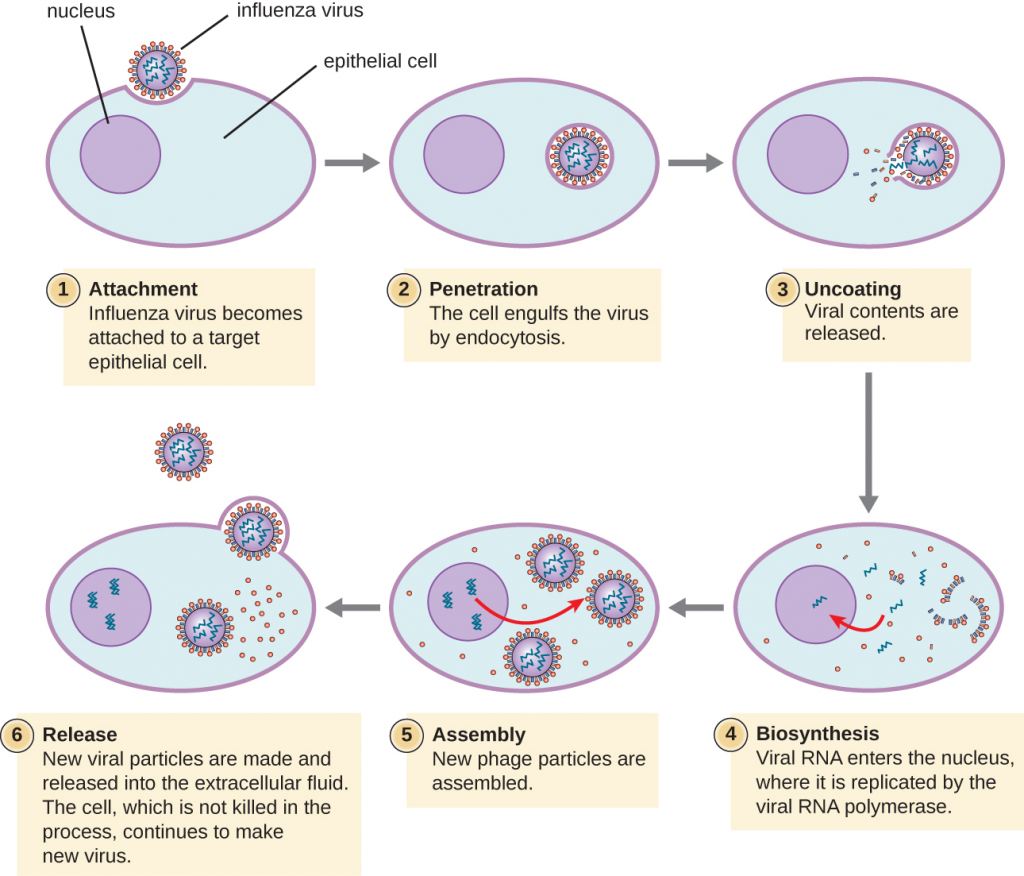
Indications for Use: Tamiflu (oseltamivir) is used to target the influenza virus by blocking the release of the virus from the infected cells.
Mechanism of Action: Tamiflu prevents the release of virus from infected cells. It is a neuraminidase inhibitor against influenza A and B.
Special Administration Considerations: This medication does not cure influenza, but can decrease flu symptoms and shorten the duration of illness if taken in a timely manner. Ckients are prescribed the medication for prophylaxis against infection, known exposure, or to lesson the course of the illness. If clients experience flu-like symptoms, it is critical that they start treatment within 48 hours of symptom onset.
Client Teaching & Education: Clients who are being treated with antiviral therapy should be instructed about the importance of medication compliance. They may also experience significant fatigue, so periods of rest should be encouraged.[4]
The influenza virus is one of the few RNA viruses that replicates in the nucleus of cells. Antivirals block the release stage. See Figure 12.15b.[5]
Subclass: Antiretrovirals
Viruses with complex life cycles, such as HIV, can be more difficult to treat. These types of viruses require the use of antiretroviral medications that block viral replication. (See Figure 3.12 to view the viral replication process of HIV.)[6] Additionally, antiretrovirals fall under the class of antiviral medications.
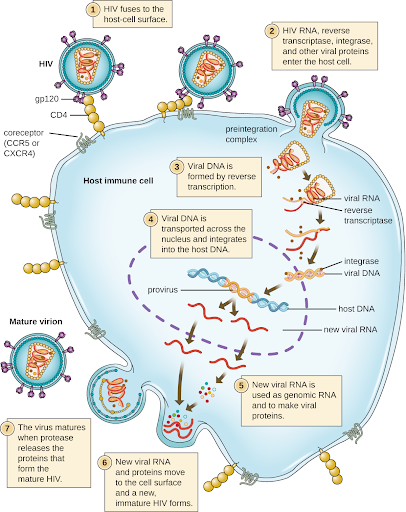
Indications for Use: Antiretrovirals are used for the treatment of illnesses like HIV.
Mechanism of Action: Antiretrovirals impede virus replication.
Special Administration Considerations: Many antiretrovirals may impact renal function; therefore, the client’s urine output and renal labs should be monitored carefully for signs of decreased function.
Client Teaching & Education: Clients who are being treated with antiviral therapy should be instructed about the importance of antiretroviral compliance. They may also experience significant fatigue, so periods of rest should be encouraged.[7]
Acyclovir Medication Card
Now let’s take a closer look at the medication cards for the subclasses of antivirals.[8][9][10][11][12] Because information about medication is constantly changing, nurses should always consult evidence-based resources to review current recommendations before administering specific medication.
To support your learning, you can access the Chapter 12 Antimicrobials Medication Cards This is a downloadable and editable document to allow you to update and add content.
Medication Card: Antivirals/Anti-herpes
Subclass: Antiherpes
Prototypes: acyclovir
Mechanism: Cause termination of the DNA chain during viral replication.
Indications:
- Acyclovir is frequently used for the treatment of herpes and varicella virus infections, including genital herpes, chickenpox, shingles, Epstein-Barr virus infections, and cytomegalovirus infections.
- Acyclovir is not a cure for herpes but improves signs and symptoms of herpes lesions if started early. It reduces the viral shedding and decreases the severity of symptoms.
- Can be used long term for prevention of outbreaks
Administration
- Route: PO, IV, or topical; do not give IM or subcutaneously (subqutaneously)
- Give with food if GI distress
- IV: Give IV infusion over at least 1 hour to prevent renal tubular damage
- Use cautiously if renal impairment, neurological problems, or dehydration
- Start therapy as early as possible after signs or symptoms occur
- Encourage fluid intake
- Check for allergies
Side Effects
- GI distress: nausea, diarrhea.
- Monitor renal function in long-term use, especially if renal impairment
- Lowers seizure threshold
Nursing Considerations
- Discuss importance of medication compliance
- Monitor for significant fatigue
- Avoid sexual contact while lesions present
Medication Card: Antivirals
Sub-Class: Anti-influenza Agents
Prototype: Oseltamivir (Tamiflu)
Mechanism: Prevents release of virus from infected cells. This results in a reduction in the duration of the flu symptoms.
Indications: Oseltamivir is used to target the influenza virus by blocking the release of the virus from the infected cells.
Administration
- Check for allergies
- Route: PO
- Must be given within 48 hours of onset of symptoms
- Administer with food to avoid GI distress
Side Effects
- GI distress
- Serious skin/ hypersensitivity reactions; discontinue immediately
- Monitor for neuropsychiatric symptoms
- Use cautiously in patients with renal failure, chronic cardiac or respiratory diseases, or any medical condition that may require imminent hospitalization
Nursing Considerations:
- Does not replace need for annual influenza vaccination
- Monitor for symptoms of the flu
Medication card: Antivirals
Sub Class: Anti-hepatitis agents
Prototype: Adefovir
Mechanism of Action: A nucleotide analog that blocks the enzyme reverse transcriptase, which the hepatitis B virus needs to replicate, reducing the overall viral load.
Indications: Second-line treatment for chronic hepatitis B, if other drug options are not effective.
Administration:
- Route: PO, once a day. Take with or without food.
- Prolonged therapy (>1 year or indefinitely) based on patient status
- Offer HIV testing; may promote resistance to antiretrovirals in patients with chronic HBV infection who also have unrecognized or untreated HIV infection
Side Effects
- Potential side effects include headache, abdominal pain, weakness, nausea, and diarrhea.
- Risk of nephrotoxicity
- Lactic acidosis
- Severe hepatomegally
Nursing Considerations:
- Do not stop taking medication unless directed.
- Monitor hepatic function several months after stopping therapy
Medication Card: Antivirals
Sub Class: Anti-retrovirals
Prototype: Lamivudine- zidovudine
Mechanism of Action: Lamivudine and zidovudine tablet, a combination of 2 nucleoside analogue reverse transcriptase inhibitors, is indicated in combination with other antiretroviral agents for the treatment of HIV-1 infection.
Indications:
- Antiretrovirals are used for the treatment of illnesses like HIV. Decreases chance of developing acquired immunodeficiency syndrome (AIDS) and HIV-related illnesses such as serious infections or cancer
- Lamivudine used to treat HIV-1 infection contains a higher dose of the active ingredient than the lamivudine used to treat chronic HBV infection. Patients with HIV-1 infection should receive only dosing forms appropriate for HIV-1 treatment
Administration:
- IV or oral dosing
- Use cautiously in patients with renal or hepatic impairment
Side Effects
- Common side effects include nausea, diarrhea, headache, malaise and fatigue.
- Lactic acidosis
- Severe hepatomegaly
- Risk of pancreatitis: stop treatment immediately if symptoms develop.
- Risk of anemia and/or neutropenia for those with advanced disease.
Nursing Considerations
- Inform patient that drug doesn’t cure HIV infection, that opportunistic infections and other complications of HIV infection may still occur, and that transmission of HIV to others through sexual contact or blood contamination is still possible.
- Taking these medications, along with practicing safer sex and making other lifestyle changes, may decrease the risk of transmitting (spreading) the HIV or hepatitis B virus to other people.
- Teach symptoms of pancreatitis
- Prolonged use of this med may cause myopathy.
Clinical Reasoning and Decision-Making Activity
Using the above information, consider the following clinical scenario question:
A client is prescribed oseltamivir (Tamiflu) for influenza symptoms. The client states to the nurse, “I hope this medication works quickly! I have felt lousy for the past 5 days!” What is the nurse’s next best response?
Note: Answers to the Clinical Reasoning Activities and Critical Thinking questions can be found in the Chapter 12: Antimicrobial Medications answer key – Fundamentals of Nursing Pharmacology – 2nd Canadian Edition section at the end of the book.
References
-
“Unknown” by CNX OpenStax is licensed under CC BY 4.0 Access for free at https://openstax.org/books/microbiology/pages/1-3-types-of-microorganisms ↵
-
This work is a derivative of Microbiology by OpenStax licensed under CC BY 4.0. Access for free at https://openstax.org/books/microbiology/pages/1-introduction ↵
-
uCentral from Unbound Medicine. https://www.unboundmedicine.com/ucentral ↵
-
uCentral from Unbound Medicine. https://www.unboundmedicine.com/ucentral ↵
-
“Unknown” by CNX OpenStax is licensed under CC BY 4.0 Access for free at https://openstax.org/books/microbiology/pages/6-2-the-viral-life-cycle ↵
-
This work is a derivative of “HIV Virus Replication Cycle” by NIAID is licensed under CC BY 2.0 ↵
-
uCentral from Unbound Medicine. https://www.unboundmedicine.com/ucentral ↵
-
Daily Med, https://dailymed.nlm.nih.gov/dailymed/index.cfm, used for hyperlinked medications in this module. Retrieved June 27, 2019 ↵
-
UpToDate (2021). Acyclovir. https://www.uptodate.com/contents/search ↵
-
UpToDate (2021). Oseltamivir. https://www.uptodate.com/contents/search ↵
-
UpToDate (2021). Adefovir. https://www.uptodate.com/contents/search ↵
-
UpToDate (2021). Lamivudine-Zidovudine. https://www.uptodate.com/contents/search ↵