8.12 Leukotriene Receptor Antagonists
Leukotriene receptor antagonists are used to prevent and treat chronic asthma. They are only used for maintenance therapy, and often if inhaled corticosteroids (ICS) are not enough or if they are not to be used. There are two commonly used meds, zafirlukast and montelukast. Zileuton, a leukotriene synthesis inhibitor, may also be used. Montelukast is taken orally, and is generally a well-tolerated, safe med.
Our prototype med will be montelukast.
Mechanism of Action
Recall that leukotrienes are inflammatory mediators derived from arachidonic acid. When asthma is triggered, the leukotriene enzyme is released by mast cells along with other inflammatory mediators, binding to highly selective receptors on bronchial smooth muscle and other airway tissues. This leads to bronchial smooth muscle constriction, an increase in mucous gland secretion, and blood vessel permeability leading to edema in the airways. Leukotrienes are what drive allergic responses, asthma and inflammation (Watanabe, Okuno & Yokomizo, 2019).
Montelukast blocks leukotriene (CysLT1) receptors in the airways which prevents the migration of inflammatory cells and prevents smooth muscle contraction. This results in reduced inflammation, bronchodilation, decreased mucous, and decreased vascular permeability.
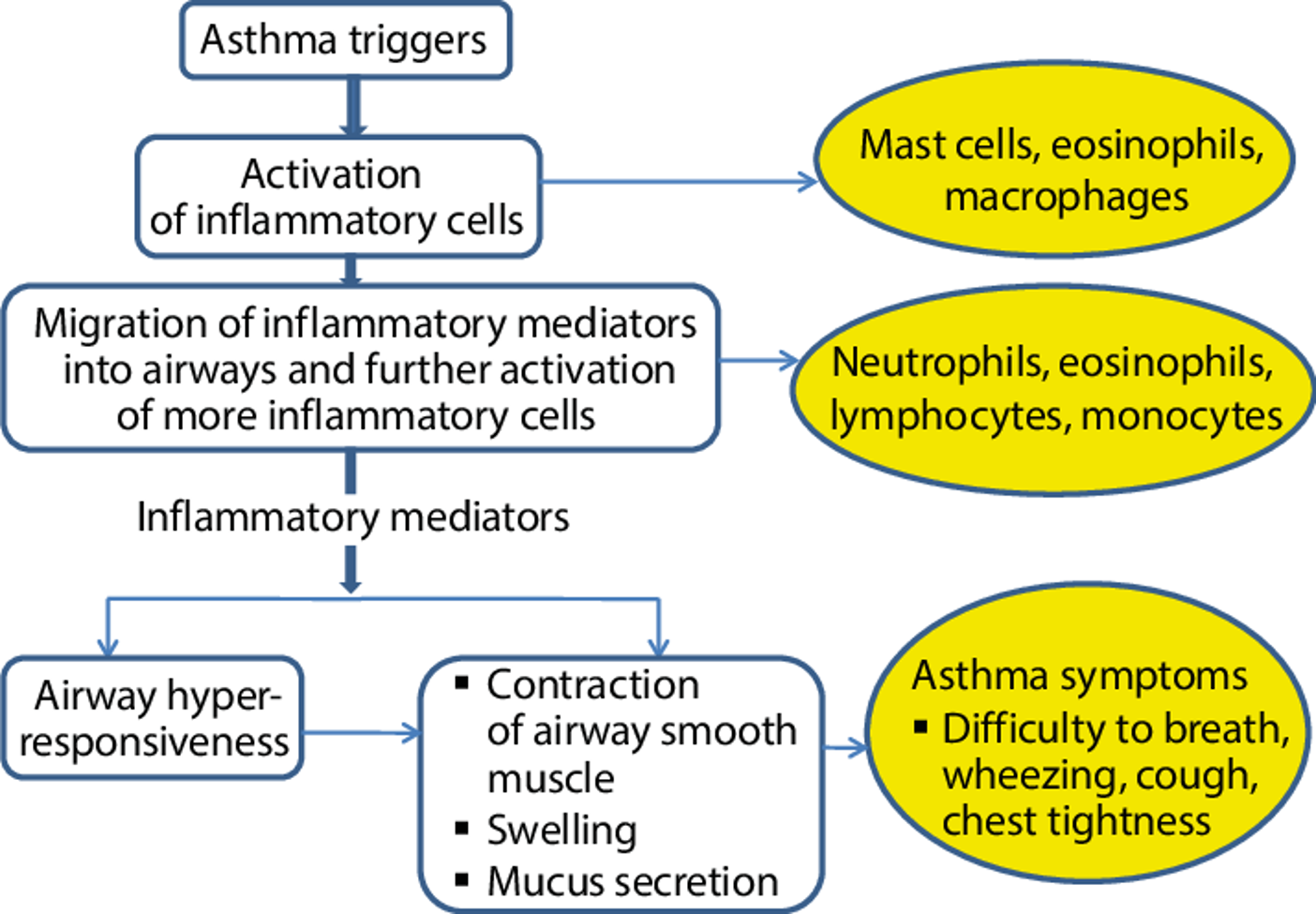
This image is distributed under the terms of the Creative Commons Attribution 3.0 Unported (CC BY 3.0) (https://creativecommons.org/licenses/by/3.0/) https://www.researchgate.net/figure/arious-inflammatory-mediators-tissues-and-cell-interactions-in-the-airways_fig2_370526518
Indications for Use
Montelukast is used for the long-term control of asthma and for decreasing the frequency of asthma attacks. It is also indicated for exercise-induced bronchospasm and allergic rhinitis. It is not used for COPD. It can be used as monotherapy or as adjunct therapy along with an inhaled corticosteroid.
Nursing Considerations
Administration: oral, available in granule packets, tablets and chewable tablets.
- Can be taken with or without food.
- For asthma, take in the evening. For allergic rhinitis, take either morning or evening. For exercise-induced bronchospasm, take two hours before exercise to prevent an attack. (Choi & Azmat, 2023).
- Slow onset of action, within 24 hours with full effect over days.
- Granule packet: Once opened, use within 15 minutes. Can be taken with soft foods, such as apple sauce.
Monitoring:
- Prior to starting montelukast, obtain a baseline respiratory assessment. Reassess periodically.
- Monitor closely for behavioural changes such as depression or suicidal thoughts.
- Assess for development of a rash, risk of Steven-Johnson syndrome. Symptoms such as fever, malaise, muscle or joint pain, blisters, oral lesions
Safe for pediatrics depending on formulation and during pregnancy based on benefit-risk.
Minimal drug interactions
Use cautiously if client has phenylketonuria, hepatic impairment (decrease dosage).
(Choi & Azmat, 2023; Vallerand & Sanoski, 2024)
Adverse/Side Effects
Minimal side effects such as nausea, diarrhea, headache, fatigue, dyspnea and sleep disturbance (Frandsen & Pennington, 2018). Children may experience diarrhea, nausea, laryngitis, sinusitis, or viral infections (Choi & Azmat, 2023).
May elevate liver function enzymes, monitor regularly.
Less common, neuropsychiatric disorders such as depression, aggression, suicidal ideation, anxiety or nightmares. Assess risk before initiating therapy, such as a history of depression. Monitor for these effects and take necessary precautions to ensure client safety.
Client Teaching
- Clients should be instructed to take medications at the same time each day and at least two hours prior to exercise. Do not double up doses.
- Inform client and caregiver of risk of depression, suicidal ideation or other change in behaviour. Careful monitoring and report any change in behaviour.
- Advise client montelukast is not used for acute bronchospasm.
- They should not discontinue medications without notifying the healthcare provider.
Montelukast Medication Card
Now let’s take a closer look at the medication card on montelukast (Adams et al, 2020; Vallerand & Sanoski, 2024; Verarde, 2020). Because information about medication is constantly changing, nurses should always consult evidence-based resources to review current recommendations before administering specific medication.

Downloadable file (.docx): Montelukast Medication Card
Critical Thinking and Decision-Making Questions
- A client is prescribed montelukast, a leukotriene receptor antagonist. Which statement informs the nurse that the client needs further health teaching?
- I can use this med for an acute asthma attack.
- If I have a change in behaviour, such as depressed mood, I should tell my prescriber.
- It doesn’t matter if I eat food while taking the med.
- If I miss a dose one day, I will not double up the dose the following day.
- True or False: Ensure to shake the montelukast inhaler and attach a spacer prior to taking the dose.
Note: Answers to the Clinical Reasoning Activities and Critical Thinking questions can be found in the Chapter 8: Respiratory Medications Answer Key V2 – Fundamentals of Nursing Pharmacology – 2nd Canadian Edition section at the end of the book.
References
Adams, M., Holland, N., & Urban, C. (2020). Pharmacology for nurses: A pathophysiologic approach (6th ed.). pp. 622-63 & 626. Pearson. ↵
Choi, J. & Azmat, C. (2023). Leukotriene receptor antagonists. National Library of Medicine. StatPearls [Internet]. https://www.ncbi.nlm.nih.gov/books/NBK554445/
Daily Med (2026). Montelukast. U.S. National Library of Medicine. DailyMed – MONTELUKAST SODIUM granule
Frandsen, G. & Pennington, S. (2018). Abrams’ clinical drug: Rationales for nursing practice (11th ed.). Wolters Kluwer.
Vallerand, A. & Sanoski, C. (2024). Davis’s Canadian drug guide for nurses (19th ed.). F.A. Davis Company: Canada
Verarde, G. (2020). Pharmacology Notes: Nursing Implications for Clinical Practice by Gloria Velarde licensed under CC BY-NC-SA 4.0
Watanabe, A., Okuno, T. & Yokomizo, T. (2019). The role of leukotrienes as potential therapeutic targets in allergic disorders. International Journal of Molecular Science, 22, 20(14), 3350. doi: 10.3390/ijms20143580
Media Attributions
- Fig. 8.12a. Various inflammatory mediators, tissues and cell interactions in the airways.
- This image is distributed under the terms of the Creative Commons Attribution 3.0 Unported (CC BY 3.0) (https://creativecommons.org/licenses/by/3.0/) https://www.researchgate.net/figure/arious-inflammatory-mediators-tissues-and-cell-interactions-in-the-airways_fig2_370526518
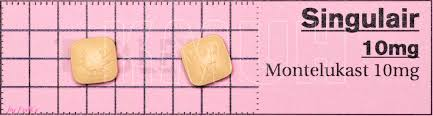
- 8.12b “Singulair 10mg” by FedEx is licenced under CC BY-NC-ND 2.0 ↵