8.11 Corticosteroids
Corticosteroids are a widely prescribed and effective medication class for long term management of airway inflammation. To suppress airway inflammation, inhalation formulas are routinely prescribed for their localized action. Examples include fluticasone, budesonide and beclomethasone. Given regularly, these meds can reduce the frequency of asthma symptoms, bronchial hyperresponsiveness and risk of exacerbation (Liang & Chao, 2023). Most of the meds in this class all end in ‘one.’ For example, beclomethasone, fluticasone, and mometasone.
In more severe cases, glucocorticoids can also be given orally (prednisone) or intravenously (methylprednisolone) to get the respiratory disease under control or for long term management. The risk of adverse effects with systemic corticosteroids are high especially if used long term so they are used judiciously. For example, a client will often be on a short term treatment with prednisone to get the bronchial inflammation under control, and then go back to only using inhalers.
Additional information about corticosteroids and potential adrenal effects is located in the “Endocrine” chapter.
Our prototype drug will be fluticasone.
Mechanism of Action
All corticosteroids act as an anti-inflammatory and immune modifier. Inhaled corticosteroids work directly at the cellular level within the bronchioles reversing capillary permeability and lysosomal stabilization to reduce inflammation (Laing & Chao, 2023). Inhaled corticosteroids do not provide immediate effect, but work gradually that can take up to a few weeks to reach maximum effect.
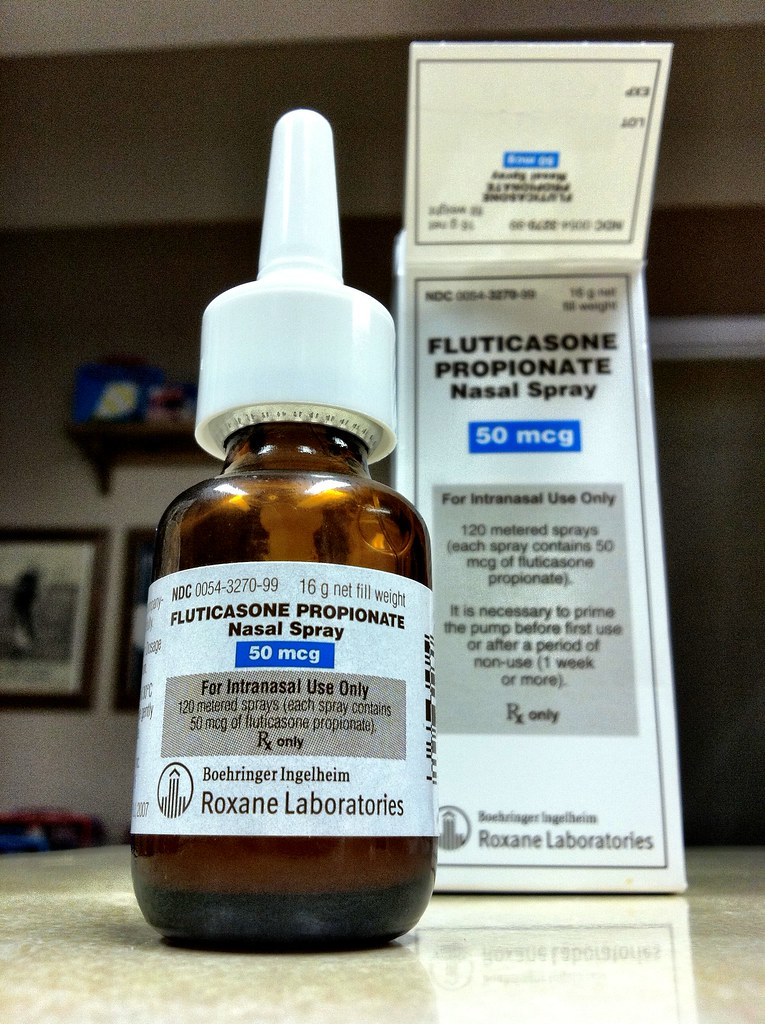
Fluticasone is a locally-acting anti-inflammatory and immune modifier. The nasal spray is used for allergies, and the oral inhaler is used for long-term control of asthma. Fluticasone is also used in a combination product with salmeterol. It decreases the frequency and severity of asthma attacks and improves overall asthma symptoms.
Indications for Use
Inhaled Corticosteroids (ICS), such as fluticasone inhalers, are used as a prophylaxis of chronic asthma and to a lesser extent, COPD. It is used as preventative therapy to suppress inflammation. They are given on a fixed schedule, not PRN. They are part of the first line management of inflammation in asthma. As such, it is considered a ‘controller’ drug. If the client’s asthma symptoms worsen, corticosteroids can be given in a stepwise fashion, with low, medium and high-dose corticosteroids being prescribed. Corticosteroids can also be used alongside other ‘controller’ medications, such as long-acting beta-agonists or leukotriene antagonists.
Example of asthma treatment:
A client will be on an ICS and short-acting beta-2 adrenergic inhaler, salbutamol (SABA). They are symptomatic and need the SABA more than 1-2 times/week?
ICS dosage may be increased. Still symptomatic and need the SABA more than 1-2 times/week?
Long-acting beta-2 adrenergic (LABA) is added.
Other medications that can be added are leukotriene receptor modifiers and long-acting muscarinic antagonists.
Example of COPD treatment:
Start with long-acting muscarinic antagonist (LAMA), along with a SABA. Need the SABA more than 2 times/week?
- Add a long-acting beta-2 adrenergic agonist (LABA). Often LAMA/LABA meds are in a combination inhaler.
- Other medications that can be added are inhaled corticosteroids (ICS), mucolytics, phosphodiesterase-4 (PDE4) inhibitors and biologics depending on clinical response.
Nursing Considerations
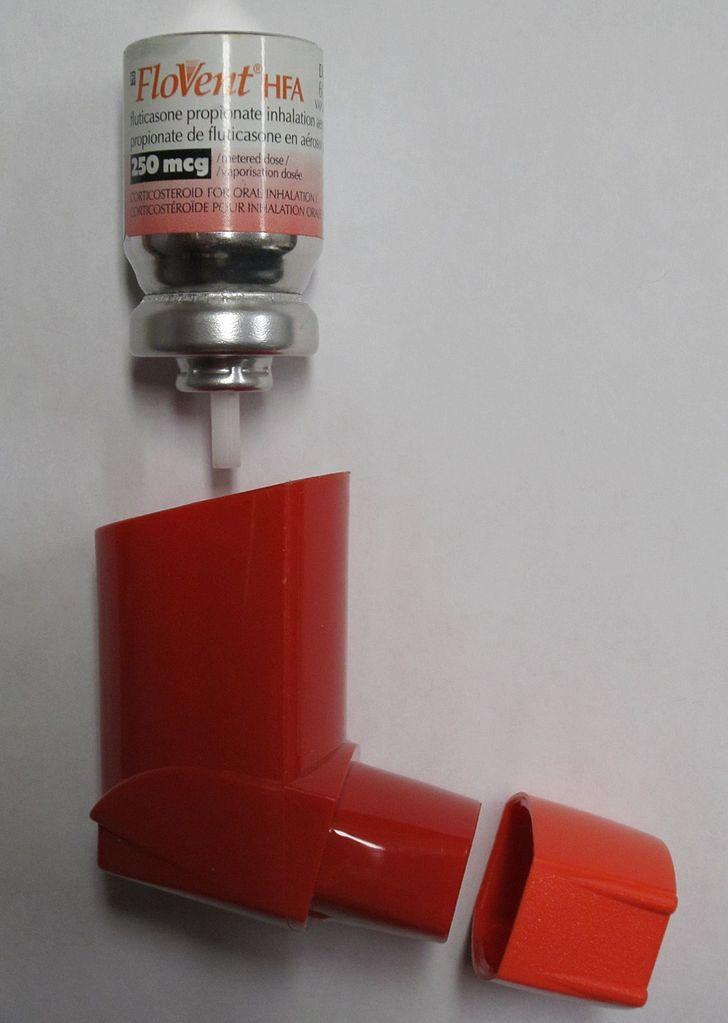
Administration: There are up to six different glucocorticoid inhalers. Fluticasone is given via MDI, twice day. Others such as budesonide are given via DPI.
Controller medications: fluticasone is always given on a fixed schedule, usually BID. If the respiratory symptoms worsen, the prescriber will determine if a higher dose is needed, even short term.
Pediatrics: Fluticasone is safe for children aged 4 years and older. Inhaled glucocorticoids can slow the growth in children, but do not prevent them from reaching full height (Liang & Chao, 2023). Watch for potential mood changes such as irritability and possible hyperactivity in children.
Long term use: risk of bone loss is minimal, contrary to the risk with using oral glucocorticoids which has significantly more systemic effects. Ensure client does weight bearing exercises, uses lowest dose possible and take calcium and vitamin D regularly. The prescriber may recommend a bone density test is done prior to therapy and periodically afterwards.
Older adult: Use with caution with the older adult with COPD as may increase risk of pneumonia.
Adverse/Side Effects
Side effects are minimal due to the localized effect of inhalation meds, mostly bypassing first-pass metabolism.
Common side effects include hoarseness, dry mouth, cough, sore throat, and oropharyngeal candidiasis. These effects are more common with high-dose inhalers. They can be minimized if a spacer is used.
Dysphonia may occur due to myopathy of laryngeal muscles and mucosal irritation.
To avoid candida infections, rinse mouth after use.
Absolute contraindications for inhaled corticosteroids are a severe hypersensitivity to milk proteins/lactose. Dry powder inhalers contain lactose as a stabilizing agent, so this form of inhaler should be avoided (Laing & Chao, 2023).
Adverse effects: although rare, may contribute to cataracts, glaucoma, hypothalamic-pituitary-adrenal axis dysfunction, and impaired glucose metabolism.

Client Teaching
- Advise clients to take the inhaler as prescribed. If taking a SABA as well, take first before the ICS.
- Do not use to treat an acute asthma attack, ICS are used as controller medications
- Inform client of common side effects such as hoarseness, and dry mouth.
- Risk of candidiasis infection, so ensure to rinse mouth with warm water after using inhaler.
- Use a spacer for medication to reach the lungs more effectively.
Fluticasone Medication Card
Now let’s take a closer look at the medication card for fluticasone.[7][8][9]

Downloadable file (.docx): Fluticasone Medication Card
Critical Thinking and Decision Making Questions
- A patient has prescriptions for two inhalers. One inhaler is a bronchodilator, and the other is a corticosteroid (ICS). Which instruction should the nurse give the patient regarding these inhalers? Pick the correct option.
a. The corticosteroid should be taken first to decrease inflammation.
b. The bronchodilator should be taken first to open up the airways.
c. Take the inhalers at least 2 hours apart. The ICS inhaler cannot be taken with other inhalers.
d. The order of the taking the inhalers does not matter with these two drugs.
2. A client will be started on fluticasone inhaler. Their friend told them that there are a lot of terrible side effects with steroid medications and they shouldn’t be on it for very long. How will the nurse respond?
Note: Answers to the Clinical Reasoning Activities and Critical Thinking questions can be found in the Chapter 8: Respiratory Medications Answer Key V2 – Fundamentals of Nursing Pharmacology – 2nd Canadian Edition section at the end of the book.
Media Attributions
- 8.11a “Fluticasone Propionate Nasal Spray” by _BuBBy_ is licensed under CC BY 2.0 ↵
- 8.11b “Fluticasone.JPG” by James Heilman, MD is licensed under CC BY-SA 4.0 ↵
- 8.11c “Asthmatic Control” by David Camerer is licensed under CC BY-NC-ND 2.0 ↵
References
- Daily Med (2026). Fluticasone Propionate. U.S. National Library of Medicine.https://dailymed.nlm.nih.gov/dailymed/drugInfo.cfm?setid=7c692ed5-959e-4c48-aeec-0799d8979693
- Frandsen, G. & Pennington, S. (2018). Abrams’ clinical drug: Rationales for nursing practice (11th ed.). Wolters Kluwer. ↵
- Liang, T. & Chao. J. (2023). Inhaled Corticosteroids. National Library of Medicine. StatPearls [Internet]. https://www.ncbi.nlm.nih.gov/books/NBK470556/
- Verlarde, G. (2020). Pharmacology Notes: Nursing Implications for Clinical Practice by Gloria Velarde licensed under CC BY-NC-SA 4.0. ↵