8.10 Anticholinergics
Anticholinergics, also known as muscarinic antagonists, are used as a bronchodilator for maintenance therapy with COPD. Ipratropium bromide inhaler is a short-acting anticholinergic and tiotropium is the long-acting option. Most meds in this class end in ‘ium’.
Additional information regarding anticholinergics can be found in the “Autonomic Nervous System” chapter.
In this unit, our prototype medication will be Ipratropium bromide.
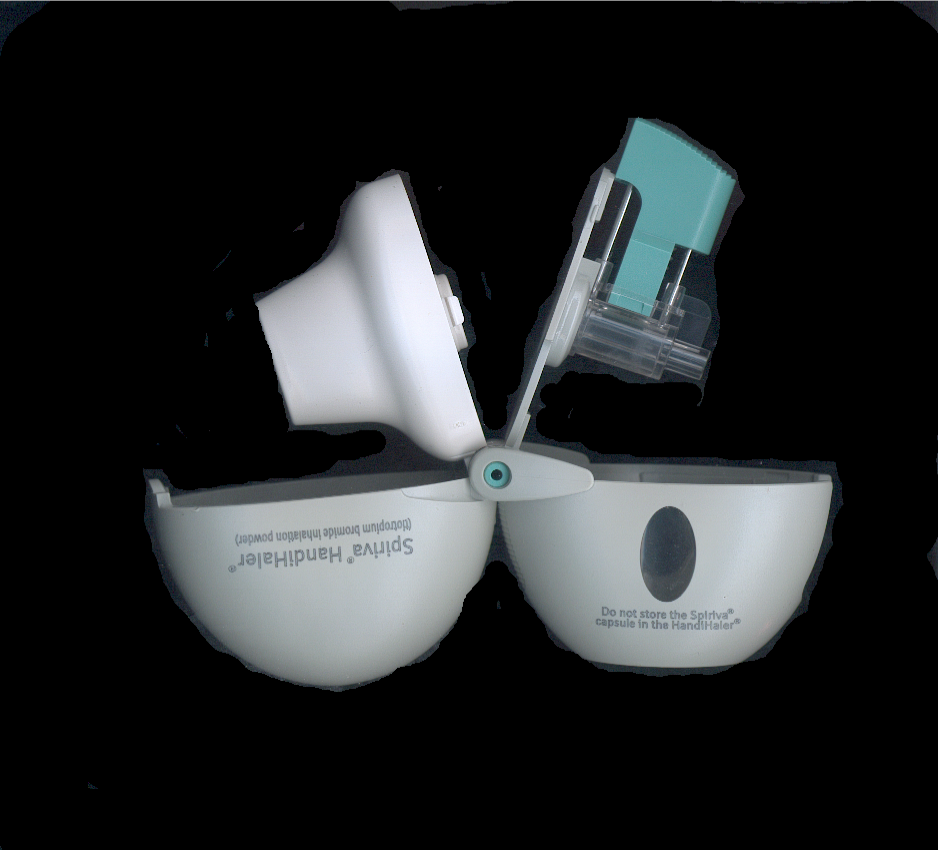
Mechanism of Action
Acetylcholine, a neurotransmitter, is released from nerve endings in the bronchial tree resulting in bronchoconstriction. Anticholinergics block the muscarinic (M3) receptors in the bronchial smooth muscle leading to bronchodilation and a decrease in mucous secretions (Liang & Chao, 2023).
Indications for Use
Anticholinergics are used for maintenance therapy of bronchoconstriction associated with COPD primarily and as an additional therapy for moderate to severe asthma. It has slow and prolonged effects so it is not used on its own for acute episodes. It is used separately or in combination inhalers with SABA or LABA meds. It is considered a ‘controller’ inhaler.
For COPD, it is often the first controller the client will be prescribed, along with a short-acting bronchodilator, salbutamol. If they use their salbutamol inhaler more then 1-2 times/week, then a long-acting beta-2 adrenergic med is ordered.
Review the following YouTube video for why the different medications are ordered for both asthma and COPD.
MedCram Medical Lectures Explained Clearly: Inhalers (Asthma Treatment & COPD Treatment) Explained! Inhalers (Asthma Treatment & COPD Treatment) Explained!
Nursing Considerations
Administration: inhaled or nasal, onset 1-2 minutes, with peak effect 1-2 hours. Duration of action 4-6 hours (Vallerand & Sanoski, 2024).
Assess respiratory status before administering and post therapy. Assess lung sounds, respiratory effort, RR, and oxygen saturations.
Combivent inhaler – salbutamol with ipratropium. Meds are combined to ease the use for the client as only one inhaler to use. Taken QID or as needed.
Adverse/Side Effects
Side effects: minimal systemic effects, mostly localized such as they may experience a dry mouth and irritation of the pharynx.
Risk of drying out secretions too well, with potential with risk of dry mucosal plugs and increased risk of infections.
(Daily Med, 2026; Liang & Chao, 2023)
Client Teaching
- Client should be instructed to use the inhaler as directed and be careful not to exceed dosage recommendations.
- They should receive education regarding the onset of the medication and differences in usage for short- and long-acting anticholinergics.
- Able to verbalize that this is not a first-line reliefer inhaler if acute bronchospasm
- Rinse mouth after use and practice good oral hygiene. Can chew sugarless gum to help with dry mouth.
- Clients with certain diseases should be cautious with using anticholinergics including myasthenia gravis, hyperthyroidism, glaucoma, enlarged prostate, hypertension, urinary tract blockage, and heart failure.
- Some long-acting anticholinergics may cause signs of angioedema and the healthcare provider should be notified if this occurs (Vallerand & Sanoski, 2024).
Ipratropium and Tiotropium Medication Card
Now let’s take a closer look at the medication card for ipratropium and tiotropium (Adams et al, 2020; Daily Med, 2026; Verlande, 2020; Frandsen & Pennington, 2018).

Downloadable file (.docx): Ipratropium and Tiotropium Medication CardCH8.10
References
- “Spiriva HandiHaler”-brand dry powder inhaler (open).png” by RonEJ at English Wikipedia is licensed under CC0 1.0 ↵
- Adams, M., Holland, N., & Urban, C. (2020). Pharmacology for nurses: A pathophysiologic approach (6th ed.). pp. 622-63 & 626. Pearson. ↵
- Daily Med (2025). Ipratropium. DailyMed – IPRATROPIUM BROMIDE solution
- Frandsen, G. & Pennington, S. (2018). Abrams’ clinical drug: Rationales for nursing practice (11th ed.). Wolters Kluwer. ↵
- Vallerand, A. & Sanoski, C. (2024). Davis’s Canadian drug guide for nurses (19th ed.). F.A. Davis Company: Canada
- Verland, G. (2020). Pharmacology Notes: Nursing Implications for Clinical Practice. Licensed under CC BY-NC-SA 4.0.