4.4 ANS Medication Classes and Nursing Considerations V2

Classes of medication, categorized according to neuroreceptor, are further discussed in more detail below. Figure 4.4 summarizes how ANS drugs are classified.
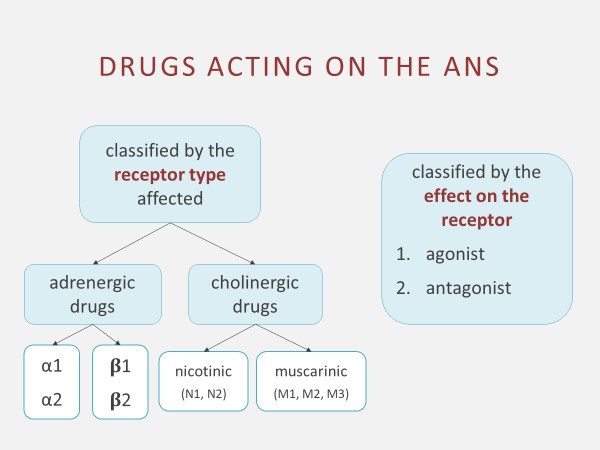
Graphic flowchart image depicting the classes of drugs acting on the ANS
Figure 4.5 Classification of drugs acting on the ANS Public Domain

Table 4.4[1] further contrasts agonist and antagonist medications for each ANS neuroreceptor.

Receptor Stimulation (Agonist) Inhibition (Antagonist)
Nicotinic
  • Nicotine is a muscle relaxant with CNS effects.
  • Nicotine patch is used for nicotine addiction by slowly reducing dose and avoiding withdrawal effects
  • Not clinically applicable
Muscarinic
  • Pilocarpine causes muscle contraction; assists with glaucoma by contracting ciliary muscle and draining fluid
  • Atropine in small doses inhibits secretions; in moderate doses increases heart rate; in large doses decreases gastrointestinal motility
Alpha-1
(found in smooth muscles)
  • Tamsulosin relaxes smooth muscle in bladder/prostate to improve urine flow and also decreases blood pressure due to vasodilation
Alpha-2
(found in brain and periphery)
  • Clonidine decreases CNS outflow to treat ADHD and also reduces blood pressure and heart rate
  • Limited clinical use
Beta-1
(found on heart and kidneys)
  • Dobutamine increases heart rate, force of heart contraction, and speed of conduction between SA to AV nodes
  • Selective B blocker: Metoprolol works on Beta-1 receptors to decrease blood pressure and heart rate
Beta-2
(found on the lungs)
  • Nonselective B blocker: Propranolol works on Beta-2 and Beta-1 receptors; decreases blood pressure but can also cause bronchoconstriction
Catecholamines stimulate multiple adrenergic receptors
  • Epinephrine and Norepinephrine: stimulate alpha- and beta-receptors on target organs, causing increased heart rate and vasoconstriction for improved blood flow to essential organs
  • Dopamine has dose-dependent effects that target arteries in the kidneys, heart, and brain
  • Not clinically applicable

Supplementary Videos:  See the supplementary videos below related to sympathetic and parasympathetic nervous system medications.

Sympathetic Nervous System Drugs

[2]


Parasympathetic Nervous System Drugs

[3]


Autonomic Nervous System Medication Cards

The Autonomic Nervous System med cards are all compiled in one document for easy use and reference. Go to the following link which will take you to Chapter 4 ANS-Regulation Medication Cards 2026.


References

Forciea, B. (2018, January 12). Sympathetic nervous system drugs [Video]. YouTube. https://youtu.be/-e_s-jTPtm4

Forciea, B. (2018, February 2). Parasympathetic nervous system drugs [Video]. YouTube. https://youtu.be/ZSRk_NkbBPg

U.S. National Library of Medicine. (n.d.). DailyMed. https://dailymed.nlm.nih.gov/dailymed/


  1. This work is a derivative of Daily Med by U.S. National Library of Medicine in the public domain
  2. Forciea, B. (2018, January 12). Sympathetic nervous system drugs. [Video]. YouTube. All rights reserved.  Video used with permission.  https://youtu.be/-e_s-jTPtm4
  3. Forciea, B. (2018, February 2). Parasympathetic nervous system drugs. [Video]. YouTube. All rights reserved. Video used with permission. https://youtu.be/ZSRk_NkbBPg

License

Icon for the Creative Commons Attribution 4.0 International License

Fundamentals of Nursing Pharmacology - 2nd Canadian Edition Copyright © 2026 by Andrea Sullivan Degenhardt is licensed under a Creative Commons Attribution 4.0 International License, except where otherwise noted.

Share This Book