6.1 Pain and Mobility Concepts
Concepts Related to Pain
This resource provides a basic introduction to the concept of pain as it relates to pharmacology. The perception of pain tells us that there is an injury of some sort, and we need to do something to alleviate that pain. Pain is subjective, so one person may experience the same pain stimulus differently than another, based on the complex interactions including past and present pain experiences, emotions, behaviours, social and physical factors.
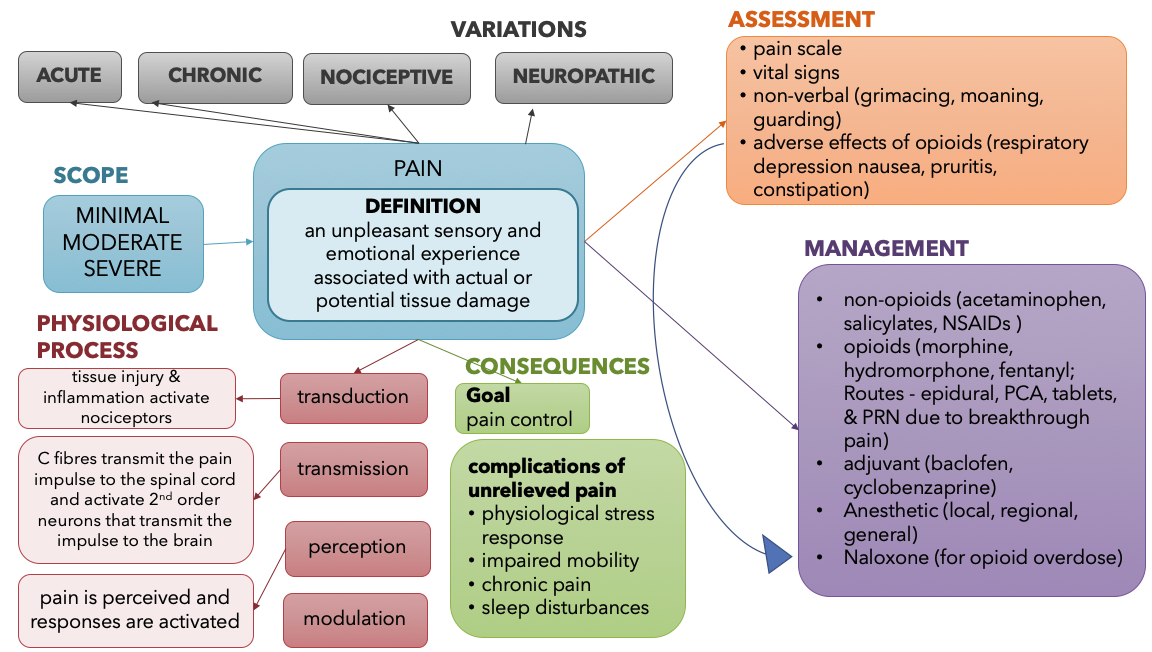
The example concept map in figure 6.1a provides a summary of the key information necessary to understand pain informed by several resources (Giddens, 2014)
You are encouraged to revisit this map after you have completed the chapter.
Before addressing the medications that are used to treat analgesic and musculoskeletal conditions in our clients, it is important to review the physiology of pain and the anatomy of the musculoskeletal system.
Physiology of Pain
Pain occurs when there is tissue damage in the body in response to a noxious stimuli. The noxious stimuli can be from thermal, mechanical, or chemical sources which then activates pain receptors of peripheral nerves. Nociceptors, the nerve endings that respond to painful stimuli, are located in arterial walls, joint surfaces, muscle fascia, periosteum, skin, and soft tissue. Nociceptors are barely present in most internal organs (Frandsen, & Pennington, 2018
The cause of tissue damage may be thermal (e.g. heat, cold), physical (e.g., pressure, stretch, spasm, and ischemia) or chemical (pain-producing substances are released into the extracellular fluid surrounding the nerve fibers that carry the pain signal). These pain-producing substances activate pain receptors, increase the sensitivity of pain receptors, or stimulate the release of inflammatory substances. Inflammatory substances include prostaglandins (Frandsen, & Pennington, 2018), substance P., histamine, globulin, protein kinases, arachidonic acid, and others. Pain can also activate the physiological stress response (Finnerty, 2017).
Two important inflammatory substances in response to a painful stimulus
Substance P – an inflammatory neuropeptide has an important role in the perception of pain. It is released by sensory nerve fibers in response to tissue damage and activates nuruokinin-1 receptors on neurons in the spinal cord, leading to increased pain signals and pain sensitivity. It has a role in inflammation, vasodilation, and immune cell activation.
Prostaglandin – is a hormone like substance produced at sites of tissue damage or infection and have a key role in the inflammatory response and pain. There are a number of types of PG, and have different effects including BP control and blood clotting.
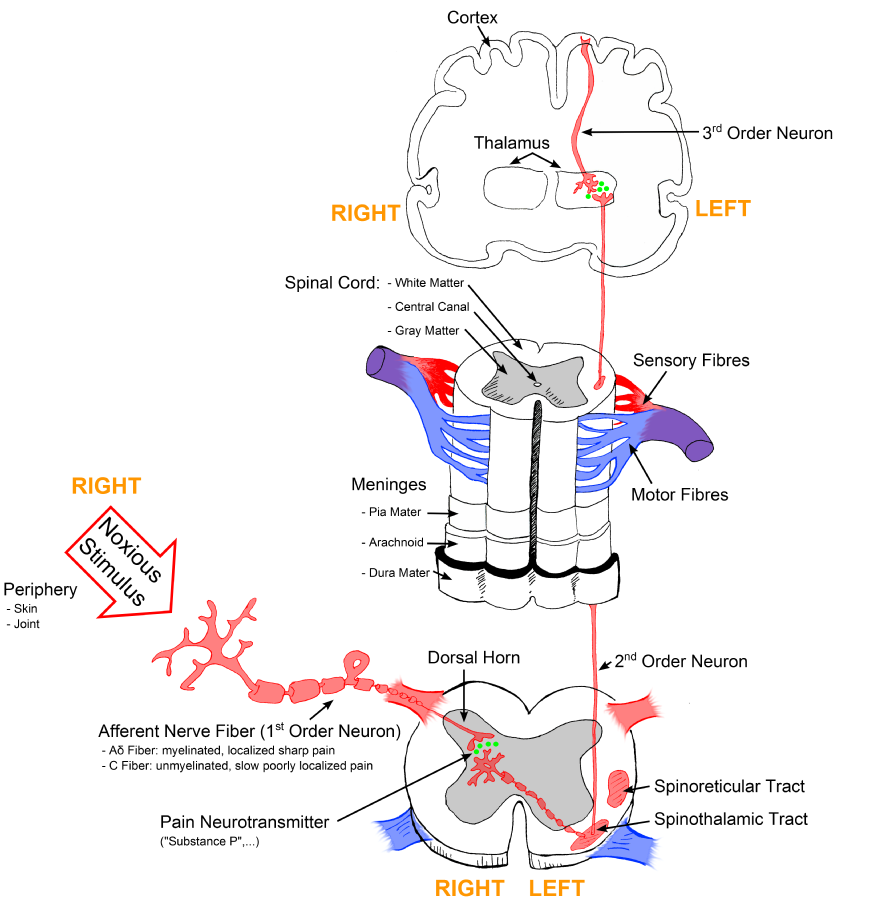
For a person to feel pain, the signal from the nociceptors in peripheral tissues must be transmitted to the spinal cord and then to the hypothalamus and cerebral cortex of the brain. The signal is transmitted to the brain by two types of nerve cells. The two types of nerve fibers, A and C, have different speed of conduction and type of pain.
The activation of A fibers (large, myelinated: transmit touch, pressure, temp quickly) send pain response quickly and is a sharp defined pain. The activation of C fibers (small diameter, slow, unmyelinated; carry pain and temp signals) is perceived as a dull, achy or burning sensation.
The dorsal horn of the spinal cord is the relay station for information from these fibers. In the brain, the thalamus is the relay station for incoming sensory stimuli, including pain. From the thalamus, the pain messages are relayed to the cerebral cortex where they are perceived (Chen et al, 2024; Frandsen, & Pennington, 2018).
See Figure 10.2b for an illustration of how the pain signal is transmitted from peripheral tissues to the spinal cord and then to the brain (Guebeli, 2015)
Perception of Pain
How do people feel pain differently, despite the same pain stimulus? To help explain this phenomenon, the concept of a gated system that allows some pain signals to reach the brain while others do not was theorized by two researchers in 1965. The Gate Control Theory introduced by Ronald Melzack and Patrick Wall explains how the pain response travels to the brain to elicit a response (as outlined above), and also explains how non-pain sensations such as touch, temperature or pressure or even emotions can also travel to or from the brain along different nerve fibers to quickly inhibit the response.

Open and closed Gates:
‘Gates’ opened when injury occurs …. Signal to cerebral cortex…. pain is felt.
‘Gates’ are closed – inhibition of impulse transmission to the brain or from emotional/cognitive processes … decrease in pain perception.
For example, pain can be minimized through touch or pressure. By rubbing an area, this sends a stimuli through the DCML into the dorsal gray horn, up the same side (as the injury) of the spinal cord to the medulla, to the thalamus and signals a decrease in sensation.
Understanding the Gate Control Theory and pain management
Two clients are on a medical unit following a fall that resulted in the same injuries: a fractured left femur, rib fractures and generalized soft tissue injury.
Client A: first time in the hospital and he has not had any significant injury before. No other health issues, does meditation to manage stress and listens to music to take his mind off of his injury. For this client, the pain stimulus is the same, but the gates will ‘close’ due to natural endorphin release, positive emotions and ability to focus on something other than the pain. He will still feel pain, but it might be better managed.
Client B: this client has had numerous injuries and hospitalizations before, they have been in the hospital in the past, and did not have a good experience with pain control. They are also bored in the hospital, and can only think about their bad luck with this fall. For this client, the pain stimulus is the same, but the gates will stay ‘open’ due to negative emotions, boredom, focusing on their pain and past negative experience. They will feel pain, and likely more than client A, and potentially more difficult to manage.
Endogenous Analgesia
The CNS has its own endogenous analgesia system for relieving pain. Endogenous opioids are primarily produced in the brain and have multiple actions throughout the body. These opioid peptides are endorphins, enkephalins, and dynorphins, and bind to opioid receptors to inhibit the perception and transmission of pain signals, resulting in pain relief, relaxation (slow HR) and euphoria (Sprouse-Blum et al, 2010).
So why is the pain transmission process important to know? It helps us understand how clients can express the same pain experience differently. It also helps us understand how different pain treatment modalities work and why choosing the right modality can contribute to pain relief.
See the video below for more information about how pain relievers work.
How Do Pain Relievers Work? by George Zaidan[1]
The Concept of Mobility and the Musculoskeletal System
The concept of mobility is defined as “purposeful physical movement, including gross simple movements, fine complex movements, and coordination; State or quality of being mobile or movable”(Giddens, 2017).
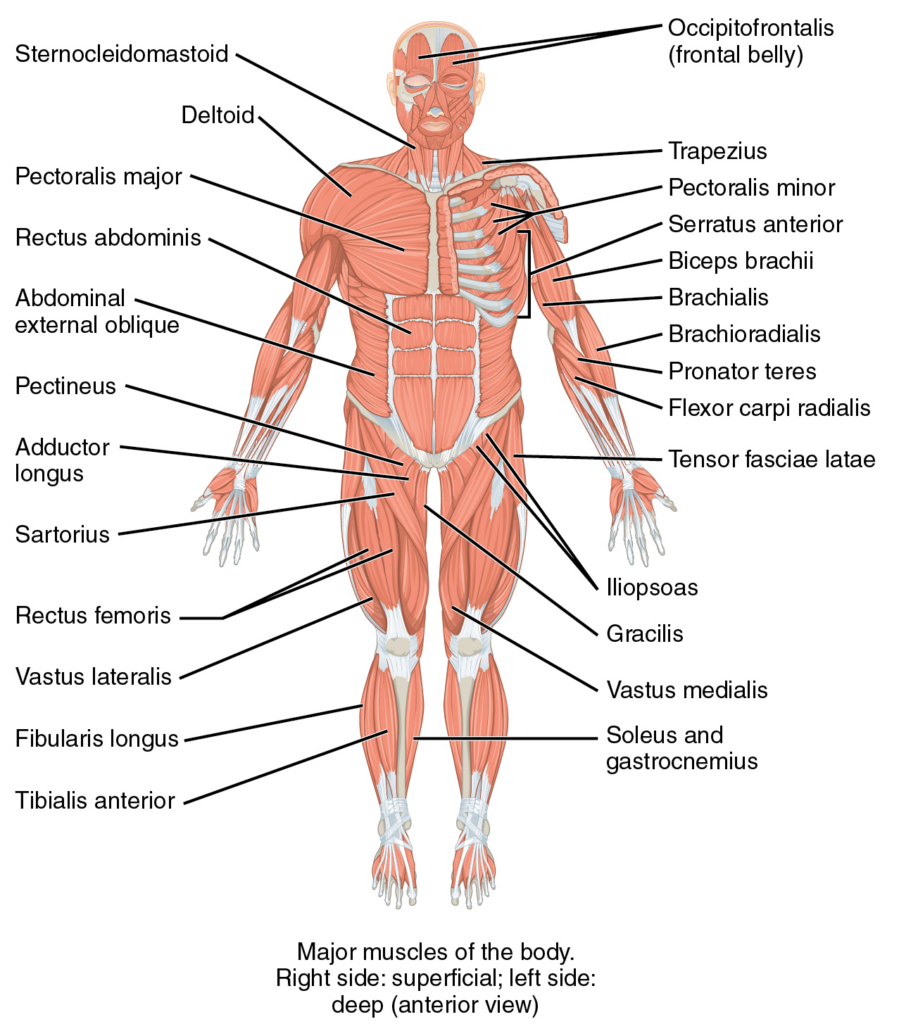
In the musculoskeletal system, the muscular and skeletal systems work together to support and move the body. The bones of the skeletal system serve to protect the body’s organs, support the weight of the body, and give the body shape. The muscles of the muscular system attach to these bones, pulling on them to allow for movement of the body (Khan Acaemy, n.d.). See Figure 10.2c for an illustration of the musculoskeletal system (Open Stax, 2015).
Muscles
The body contains three types of muscle tissue: skeletal muscle, smooth muscle, and cardiac muscle. See Figure 6.1d for images of different types of muscle (Open Stax, 2013)
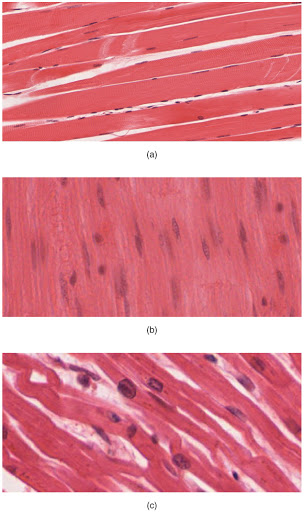
Skeletal muscle is voluntary and striated. These are the muscles that attach to bones and control conscious movement. Smooth muscle is involuntary and non-striated. It is found in the hollow organs of the body, such as the stomach, intestines, and around blood vessels. Cardiac muscle is involuntary and striated. It is found only in the heart and is specialized to help pump blood throughout the body (Khan Academy, n.d.)
When a muscle fiber receives a signal from the nervous system, myosin filaments are stimulated, pulling actin filaments closer together. This shortens sarcomeres within a fiber, causing it to contract (Khan Academy, n.d.)
Image Description
Figure 10.2a Pain Concept Map image description: This is a concept map that shows the components of pain. It starts with the definition for pain: an unpleasant sensory and emotional experience associated with actual or potential tissue damage. Then, the concept map continues through the following categories:
Scope
- Minimal
- Moderate
- Severe
Variations
- Acute
- Chronic
- Nociceptive
- Neuropathic
Assessment
- pain scale
- vital signs
- non-verbal (grimacing, moaning, guarding)
- adverse effects of opioids (respiratory depression nausea, pruritis, constipation)
Management
- non-opioids (acetaminophen, salicylates, NSAIDs )
- opioids (morphine, hydromorphone, fentanyl; Routes – epidural, PCA, tablets, & PRN due to breakthrough pain)
- adjuvant (baclofen, cyclobenzaprine)
- Anesthetic (local, regional, general)
- Naloxone (for opioid overdose)
Consequences
- Goal
- pain control
- complications of unrelieved pain
- physiological stress response
- impaired mobility
- chronic pain
- sleep disturbances
Physiological Process
- Transduction
- tissue injury & inflammation activate nociceptors
- Transmission
- C fibres transmit the pain impulse to the spinal cord and activate 2nd order neurons that transmit the impulse to the brain
- Perception
- pain is perceived and responses are activated
- Modulation [Return to Figure 10.2a]
Interactive Activities
References
Chen, S., Kandle, P., Murray, I.,Fitzgerald, L., & Sehdev, J. (2023). Physiology, Pain. National Library of Medicine. StatPearls [Internet]. Physiology, Pain – StatPearls – NCBI Bookshelf
Giddens, J. (2017). Concepts of Nursing Practice (2nd ed.) Missouri: Elsevier.
Finnerty, C., Mabvuure, N., Ali, A., Kozar, R., & Herndon, D. (2014). The Surgically Induced Stress Response. https://www.ncbi.nlm.nih.gov/pmc/articles/PMC3920901/ ↵
Frandsen, G. & Pennington, S. (2018). Abrams’ clinical drug: Rationales for nursing practice (11th ed.), pg. 305, 310, 952-953, 959-960. Wolters Kluwer. ↵
Khan Academy. (n.d.). The musculoskeletal system review.https://www.khanacademy.org/science/high-school-biology/hs-human-body-systems/hs-the-musculoskeletal-system/a/hs-the-musculoskeletal-system-review
Khan Academy. (n.d.). The musculoskeletal system review. https://www.khanacademy.org/science/high-school-biology/hs-human-body-systems/hs-the-musculoskeletal-system/a/hs-the-musculoskeletal-system-review ↵
Khan Academy. (n.d.). The musculoskeletal system review. https://www.khanacademy.org/science/high-school-biology/hs-human-body-systems/hs-the-musculoskeletal-system/a/hs-the-musculoskeletal-system-review
Sprouse-Blum, Smith, G., Sugain, D. & Parsa, F. (2010). Understanding Endorphins and Their Importance in Pain Management. Hawaii Medical Journal, 69(30), 70-71. PMCID: PMC3104618 PMID: 20397507
Images:
Gate Image: https://pixabay.com/photos/moselle-gate-iron-gate-2635914/
“Sketch colored final.png” by Bettina Guebeli is licensed under CC BY-SA 4.0 ↵
Ted-Ed. (2012, June 26). How Do Pain Relievers Work? – George Zaidan [Video]. YouTube. https://youtu.be/9mcuIc5O-DE ↵
This image is a derivative of “1105 Anterior and Posterior Views of Muscles.jpg” by CFCF is licensed under CC BY 4.0 ↵
“414 Skeletal Smooth Cardiac.jpg” by OpenStax College is licensed under CC BY 4.0 ↵
- Ted-Ed. (2012, June 26). How Do Pain Relievers Work? - George Zaidan [Video]. YouTube. https://youtu.be/9mcuIc5O-DE ↵
Nerve endings that selectively respond to painful stimuli and send pain signals to the brain and spinal cord.
Produced in nearly all cells and are part of the body’s way of dealing with injury and illness. Prostaglandins act as signals to control several different processes depending on the part of the body in which they are made. Prostaglandins are made at the sites of tissue damage or infection, where they cause inflammation, pain, and fever as part of the healing process.
Refers to purposeful physical movement, including gross simple movements, fine complex movements, and coordination; "State or quality of being mobile or movable."