3.6 Preventing Medication Errors V2
Despite having safety standards for prescribing, dispensing, and administering medications, medication errors continue to be a concern worldwide. Globally, medication errors and unsafe medication practices are the leading cause of client harm in healthcare systems (World Health Organization, n.d.). Medication errors occur throughout the medication use process; however, many recent studies indicate that most errors occur during prescribing and monitoring stages (World Health Organization, 2023).
Over the last few decades in Canada, there has been a national focus to reduce medication incidents with a comprehensive approach to improving client safety. Although progress has been made in client safety over the last few years, medication errors remain extremely common in both the hospital and community setting. A 2021–2022 report by the Canadian Institute of Health Information, found that 47% of the 150,000 harmful events that occurred in a hospital setting were attributed to healthcare (i.e., bed sores) and medication errors (Zelmer, 2022). In a community setting, medication incidents in pharmacies were reported at more than 24,000 incidents in 2023, with incorrect dose/frequency, incorrect quantity or incorrect drug as most reported (Institute for Safe Medication Practices Canada [ISMP Canada], 2024). In 2015, the Institute for Safe Medication Practices (ISMP) Canada published a report titled Medication Error and Patient Safety: A Systems Approach, which reported that more than 7.5% (or 187,500) patients in Canadian hospitals were seriously harmed by their care (Greenall, 2015).
The national healthcare system continues to implement initiatives at all levels to prevent errors. Based on results from incident report data, the Canadian Patient Safety Institute (CPSI, 2014), in partnership with ISMP Canada, created a Medication Safety Action Plan to accelerate improvements in safe medication use in Canada. The action plan covers five major themes:
- Reporting, learning and sharing: focus on reporting medication safety events, but also actively and mindfully share results with relevant parties.
- Evidence-informed practices: focus on developing and implementing evidence-informed guidelines for clinical practice to improve medication safety.
- Partnering with patients: shift the professional culture to encourage open sharing of information between providers and clients.
- Education: ensure clients have access to plain-language resources related to medication safety, and ensure each member of the interdisciplinary team has a clear understanding of their roles with medication safety.
- Technology: integrate healthcare system technologies, while addressing privacy concerns.
The plan outlines clear goals and actions that health authorities can take in order to mitigate medication errors.
ISMP Canada emphasized systems-based actions that healthcare organizations, providers, and policy-makers/regulators can take to improve medication safety. These recommendations included actions such as:
- automation or computerization of medication dispensing,
- standardization of order sets,
- electronic order sets, and
- improved policies/guidelines on medication administration.
The Institute of Medicine (IOM) and ISMP Canada also emphasize actions that individual clients can take to prevent medication errors, such as maintaining active medication lists and bringing their medications to appointments for review (Aspden, et al., 2007; Greenall, 2015).
Health organizations have aimed to break the cycle of inaction regarding medical errors by advocating a comprehensive approach to improving client safety (Kohn et al., 2000). Part of this approach is supporting a ‘safety culture’ that shifts from blaming the individual for the error to one of a learning opportunity.
Safety Culture
According to the Institute of Medicine, “The biggest challenge to moving toward a safer health system is changing the culture from one of blaming individuals for errors to one in which errors are treated not as personal failures, but as opportunities to improve the system and prevent harm” (Joint Commission Center for Transforming Healthcare, 2021). The British Columbia Patient Safety and Quality Council (BCPSQC) develops effective solutions for healthcare’s most critical safety and quality problems with a goal to ultimately achieving zero harm to clients. The Center has also been instrumental in creating a focus on a “Safety Culture” in healthcare organizations. A safety culture empowers staff to speak up about risks to clients and report errors and near misses, all of which drive improvement in client care and reduce the incidence of client harm.
Further, many health authorities in Canada also use electronic databases to collect and use evidence to support and sustain protocols that help identify drug misuse and see gaps (for example, the BC Patient Safety Learning System (n.d.)).
As a result of the focus on creating a safety culture, whenever a medication error or a ‘near-miss’ occurs, nurses should submit a safety event report according to their institution’s guidelines. The incident report triggers a root cause analysis to help identify not only what and how an event occurred, but also why it happened. When investigators are able to determine why an event or failure occurred, they can create workable corrective measures that prevent future errors from occurring (UC Davis PSNet Editorial Team, 2024).
Safety Culture in Action
In 2006, three babies died after receiving incorrect heparin doses to flush their vascular access devices (Institute for Safe Medication Practices, 2007). A root cause analysis found that pharmacy technicians accidentally placed vials containing more concentrated heparin (10,000 units/mL) in storage locations in client care areas designated for less concentrated heparin vials (10 units/mL). Additionally, the heparin vials were similar in appearance, so the nurses did not notice the incorrect dosage until after it was administered.
In response to the root cause analysis, the hospital no longer stocks heparin 10 units/mL vials in pediatric units and uses saline to flush all peripheral lines. In the pharmacy, 10,000 units/mL heparin vials were separated from vials containing other strengths. Workable corrective measures were thus implemented to prevent future tragedies from occurring as a result of incorrect doses of heparin.
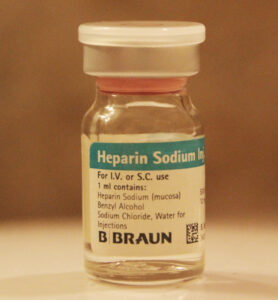
Figure 3.6a Heparin vial. Heparin is one med that has many different strengths that are used for different purposes. Nurses must ensure they are using the correct heparin by carefully reading the order, the vial and doing an independent double check.
References
Aspden, P., Wolcott, J. A., Bootman, L., & Cronenwett, L. R. (Eds.). (2007). Preventing medication errors. National Academies Press. https://nap.nationalacademies.org/catalog/11623/preventing-medication-errors
BC Patient Safety & Learning System. (n.d.). Home. https://bcpslscentral.ca/
Canadian Patient Safety Institute. (2014). A medication safety action plan [PDF]. Internet Archive. https://web.archive.org/web/20160719014915/https://www.patientsafetyinstitute.ca/en/About/PatientSafetyForwardWith4/Documents/A%20Medication%20Safety%20Action%20Plan.pdf
Greenall, J. (2015). Medication error and patient safety: A systems approach [PDF]. https://www.ismp-canada.org/download/presentations/SystemsApproach_ISMPCanada_18Nov2015.pdf
Institute for Safe Medication Practices. (2007, November 29). Another heparin error: learning from mistakes so we don’t repeat them. https://www.ismp.org/resources/another-heparin-error-learning-mistakes-so-we-dont-repeat-them
Institute for Safe Medication Practices Canada. (2024). National incident data repository for community pharmacies: National snapshot (July 2024) [PDF]. https://ismpcanada.ca/wp-content/uploads/NIDR-National-Snapshot-July-2024.pdf?utm_source=prodserv&utm_medium=email&utm_campaign=ps240829
Joint Commission Center for Transforming Healthcare. (2021). Facts about the Safety Culture Project [Fact sheet]. Internet Archive. https://web.archive.org/web/20211206214438/https://www.centerfortransforminghealthcare.org/-/media/cth/documents/improvement-topics/cth_sc_fact_sheet.pdf
Kohn, L. T., Corrigan, J. M., & Donaldson, M. S. (Eds.). (2000). To err is human: Building a safer health system. National Academies Press. https://nap.nationalacademies.org/catalog/9728/to-err-is-human-building-a-safer-health-system
UC Davis PSNet Editorial Team. (2024). Root cause analysis. Patient Safety Network. https://psnet.ahrq.gov/primer/root-cause-analysis
World Health Organization. (n.d.). Medication without harm. Retrieved October 29, 2025, from https://www.who.int/initiatives/medication-without-harm
World Health Organization. (2023). Global burden of preventable medication-related harm in health care: A systematic review. https://www.who.int/publications/i/item/9789240088887
Zelmer, J. (2022, November 21). New data shows that a focus on patient safety is more important than ever. Healthcare Excellence Canada. https://www.healthcareexcellence.ca/en/news/new-data-shows-that-a-focus-on-patient-safety-is-more-important-than-ever/
Images
3.6a Heparin vial. PanaromicTiger – Own work, CC BY-SA 3.0, https://commons.wikimedia.org/w/index.php?curid=7538488