11.1 Glucose Regulation and the Pancreas V2
The endocrine system regulates all body systems by secreting various hormones that the body releases in response to a change in the body’s internal environment. The role of hormones is to maintain the homeostasis within the body. Hormones are closely regulated by a negative feedback system. For example, as the hormone level rises so too does its action. Once homeostasis is restored, the target tissue provides negative feedback and the endocrine tissue stops secreting the hormone (Adams et al, 2018). For more information on hormone regulation, refer to chapter 10.
Pancreas
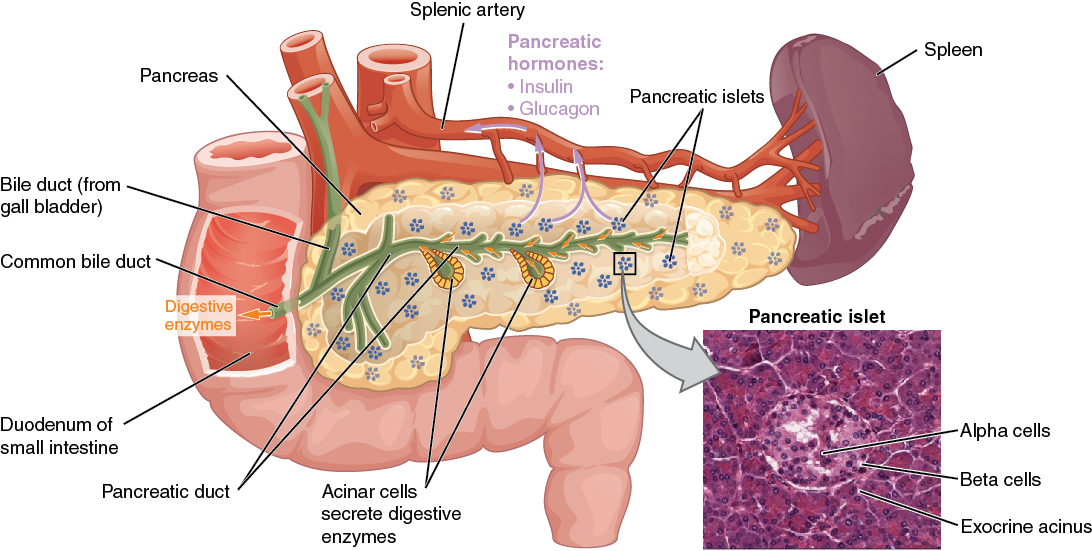
For glucose metabolism, the pancreas secretes digestive enzymes and pancreatic hormones to regulate macronutrient digestion and endocrine energy homeostasis. The pancreas is a long, slender organ located behind the stomach in the upper abdominal cavity (see Figure 11.1a).
It has two functions, exocrine and endocrine. It is primarily an exocrine gland, secreting digestive enzymes into the duodenum. These digestive enzymes include amylase, pancreatic lipase and trypsinogen. The endocrine function is the secretion of insulin and glucagon into the bloodstream. Endocrine cells, called Islets of Langerhans, are clusters of cells in the pancreas. The alpha cells secrete glucagon and the beta cells secrete insulin. Together, glucagon and insulin maintain tight control of glucose levels. Other hormones secreted by the pancreas also have a role in glucose regulation, such as somatostatin inhibits both glucagon and insulin release (Roder et al, 2016).
Regulation of Blood Glucose Levels by Insulin and Glucagon
Although there are a number of external signals that stimulate hormone release, such as nutrient intake or stress, the main stimulus for beta cells to release insulin are elevated blood glucose levels following a meal. As such, insulin release is regulated by the level of glucose in the blood. Insulin assists in glucose transport and without insulin, glucose cannot enter cells and be used for energy. Glucose is the preferred fuel for all body cells. The body derives glucose from the breakdown of the carbohydrate-containing foods and drinks we consume. Glucose not immediately taken up by cells for fuel can be stored by the liver and muscles as glycogen or converted to triglycerides and stored in the adipose tissue. Hormones regulate both the storage and the utilization of glucose as required. Receptors located in the pancreas sense blood glucose levels, and subsequently, the pancreatic cells secrete glucagon or insulin to maintain normal levels.
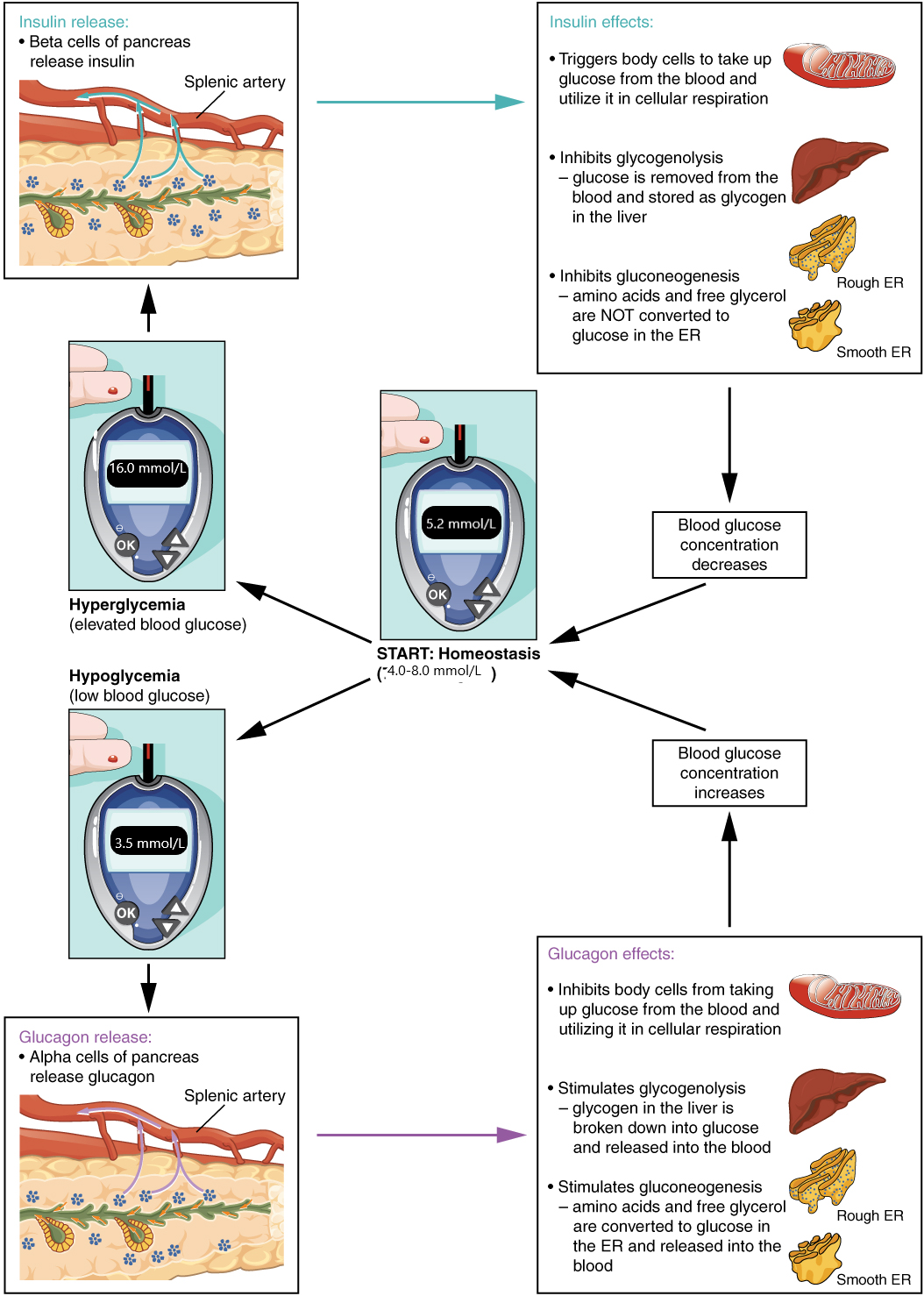
Maintenance of blood glucose levels by glucagon and insulin. When blood glucose levels are low, the pancreas secretes glucagon, which increases endogenous blood glucose levels through glycogenolysis. After a meal, when exogenous blood glucose levels are high, insulin is released to trigger glucose uptake into insulin-dependent muscle and adipose tissues as well as to promote glycogenesis.
Glucagon
Receptors in the pancreas can sense the decline in blood glucose levels, such as during periods of fasting or during prolonged labor or exercise. In response, the alpha cells of the pancreas secrete the hormone glucagon, which has several effects:
- It stimulates the liver to convert stores of glycogen back into glucose. This response is known as glycogenolysis. The glucose is then released into the circulation for use by body cells.
- It stimulates the liver to take up amino acids from the blood and convert them into glucose. This response is known as gluconeogenesis.
- It stimulates lipolysis, the breakdown of stored triglycerides into free fatty acids and glycerol. Some of the free glycerol released into the bloodstream travels to the liver, which converts it into glucose. This is also a form of gluconeogenesis.
Taken together, these actions increase blood glucose levels. The activity of glucagon is regulated through a negative feedback mechanism; rising blood glucose levels inhibit further glucagon production and secretion (Jiang & Zhang, 2003). See Figure 9.5b for an illustration of homeostatic regulation of blood glucose levels.
Insulin
Insulin facilitates the uptake of glucose into skeletal and adipose body cells. The presence of food in the intestine triggers the release of gastrointestinal tract hormones. This, in turn, triggers insulin production and secretion by the beta cells of the pancreas. Once nutrient absorption occurs, the resulting surge in blood glucose levels further stimulates insulin secretion.
Insulin triggers the rapid movement of glucose transporter vesicles to the cell membrane, where they are exposed to the extracellular fluid. The transporters then move glucose by facilitated diffusion into the cell interior.
Insulin also reduces blood glucose levels by stimulating glycolysis, the metabolism of glucose for generation of ATP. It further stimulates the liver to convert excess glucose into glycogen for storage, and it inhibits enzymes involved in glycogenolysis and gluconeogenesis. Finally, insulin promotes triglyceride and protein synthesis. The secretion of insulin is regulated through a negative feedback mechanism. As blood glucose levels decrease, further insulin release is inhibited.
Insulin is considered having a hypoglycemic effect, meaning it causes blood glucose levels to fall. Glucagon, in contrast, has a hyperglycemic effect. Endogenous glucagon is released when blood glucose levels are low and its function is to maintain glucose levels between meals (Jiang & Zhang, 2003). Its main role is to stimulate hepatic glucose output, leading to increases in glycemia. We can also give exogenous glucagon, and in these cases, glucagon can be administered IV in hypoglycemic situations.
Blood glucose levels are also regulated by other hormones such as thyroid hormones, epinephrine, corticosteroids and growth hormones. Many medications can also affect glucose levels such as beta-adrenergic blockers, non-steroidal anti-inflammatory drugs, alcohol and many more.
Media Attributions
- 11.1a “1820 The Pancreas.jpg“” by OpenStax is licensed under CC BY 4.0. Access for free at https://openstax.org/books/anatomy-and-physiology/pages/17-9-the-endocrine-pancreas ↵
- 11.2b “1822 The Homostatic Regulation of Blood Glucose Levels.jpg” by OpenStax is licensed under CC BY 4.0. Access for free at https://openstax.org/books/anatomy-and-physiology/pages/17-9-the-endocrine-pancreas ↵
- 11.1c Glucose regulation concept map description
References
Adams, M., Urban, C., El-Hussein, M., Osuji, J. & King, S. (2018). Pharmacology for Nurses. A pathophysiological approach (2nd Canadian ed.). Pearson Canada Inc: Ontario
Jiang, G. & Zhang, B. (2003). Glucagon and regulation of glucose metabolism. American Journal of Physiology-Endocrinology and Metabolism, 284 (4). https://doi.org/10.1152/ajpendo.00492.2002
Roder, P., Wu, B., Lui, Y. & Han. W. (2016). Pancreatic regulation of glucose homeostasis. Experimental and Molecular Medicine, 48, e216. https://doi.org/10.1038/emm.2016.6