1.0 Introduction to Pharmacology V2
Learning Objectives
- Identify and describe the processes of pharmacokinetics.
- Apply principles of evidence-based practice to identify pertinent information related to drugs.
- Consider pharmacodynamic differences across the lifespan.
- Differentiate among prescription drugs, over-the-counter drugs, herbals, and dietary supplements.
Introduction
To be able to administer medications safely and effectively, registered nurses require specific knowledge, skill, and judgment to ensure safe, client-centred care. To provide this safe care, nurses need a strong foundation in pharmacology, which can be defined as “the study of drugs and their interactions with living systems” (Burcham & Rosenthal, 2019), which includes learning about:
- the physical and chemical properties of drugs;
- how the drug works in the body;
- the uses of drugs for different health conditions;
- the intended and adverse effects;
- drug interactions; and
- important assessments and monitoring following administration.
The topic of pharmacology is expansive, with thousands of medications available, not including combination formulas and natural health products (Government of Canada, 2015), and each have their own therapeutic applications and characteristics. As such, this text will focus on what information is clinically relevant for nurses by learning about different medication classifications, key information about each med, and nursing considerations for safe medication administration.
Is It a Drug or a Medication?
These two terms are often used interchangeably, but they have distinct definitions. A drug is a chemical agent that is capable of producing a biological response within the body (Adams et al., 2018). A drug is considered a medication if it is medically therapeutic. This definition excludes food and other agents such as cosmetics. In most of the literature and in this text, you will see drug and medication both used and sometimes interchangeably.
The Ideal Medication
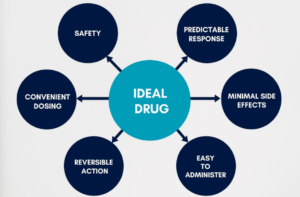
If you were developing a new medication, what would be important characteristics? You will likely consider a medication that is safe (no harmful effects to the client), effective (treats or prevents the condition 100% of the time), and selective (does exactly what it is intended to do and nothing else). Other qualities you might consider would be whether the medication is easily accessible, inexpensive, convenient, or fast acting with no drug interactions. These qualities would be ideal, but unfortunately, no medication has all these characteristics. No medication is 100% effective all the time with no negative effects. All medications have the potential to produce harmful effects regardless if they are used correctly or incorrectly. For example, if a prescriber does not consider a client’s impaired renal function and prescribes a larger dose, this can lead to adverse effects. Sometimes, medications prescribed are used correctly but have a different effect than what was expected (adverse reactions or idiosyncratic reactions). Some medications are over-the-counter (OTC), making them highly accessible and inexpensive but open to incorrect usage. For example, Ibuprofen is a highly effective pain reliever and anti-inflammatory. However, if dosages exceed recommendations or someone takes the medication for a long time, it can lead to a risk of gastric issues and drug interactions.
If there is no ideal drug, what factors determine how well a drug meets its therapeutic objective? In the upcoming units on pharmacokinetics and pharmacodynamics, we will examine many factors that influence a drug’s capability and how the same drug can work differently in different people.
To improve the client outcomes when taking any medications, a collaborative health care team approach is needed that includes the prescriber, such as a physician or nurse practitioner, the pharmacist, the nurse, and other allied health members. In Chapter 2.7 Deprescribing Medications, we will explore the implications of overprescribing, especially in the older population, and the role that all health care team members have in minimizing polypharmacy.
Safe Medication Administration in Action
Nurses need to make many decisions about medications that have a significant impact on client well-being. This begins with taking the best medication history for a new admission (see Chapter 2 Safety and Ethics) and ends with completing health teaching prior to discharge. Other examples of decisions that a nurse might make during client care include:
- Is my client’s heart rate within the correct range to receive this beta-blocker medication?
- Does my client have adequate renal function prior to administering this dose of antibiotic?
- Is this pain medication effective in controlling my client’s discomfort?
- My client is going home; what health teaching about this medication is important for ensuring the client uses it safely?
In summary, in order to make safe medication administration decisions, the nurse must have a strong understanding of pharmacology. The use of medications is strongly connected to a client’s treatment plan, including symptom management, physical recovery, and individual well-being. Before a nurse reviews a medication order, checks a medication administration record, or administers a medication, it is important to have a foundational understanding of how medications work within the human body.
Nurses should understand the key components of pharmacology:
- Pharmacotherapeutics: The clinical purpose or reason for the medication.
- Pharmacokinetics: The movement of the drug through the body.
- Pharmacodynamics: The physiological response of the body to the drug.
These next sections will introduce pharmacokinetics and pharmacodynamics. Future chapters of this textbook will focus on the pharmacotherapeutics of specific drug classifications.
Key Terms
- absorption
- adverse effects
- affinity
- agonist
- antagonist
- bioavailability
- blood-brain barrier
- clients
- distribution
- dose-response
- drugs
- duration
- efficacy
- excretion
- first-pass effect
- half-life
- mechanism of action
- medication
- metabolism
- onset
- peak
- pharmacodynamics
- pharmacogenetics
- pharmacokinetics
- pharmacology
- pharmacotherapeutics
- potency
- selectivity
- side effect
- therapeutic index
- therapeutic window
- trough
Key Term: Clients
In British Columbia, clients are defined as, “individual consumers of healthcare services who can be either a Patient or Resident or Tenant” (Health Information Management, n.d.). In this textbook, the words ‘client’ and ‘patient’ are used interchangeably.
References
Adams, M. P., Urban, C. Q., El-Hussein, M., Osuji, J. & King, S. (2018). Pharmacology for nurses. A pathophysiological approach (2nd Canadian ed.). Pearson.
Aithal, A., & Aithal, P.S. (2018). The concept of ideal drug & its realization opportunity using present pharmaceutical sciences scenario. International Journal of Health Sciences and Pharmacy (IJHSP), 2(2), 11–26. https://doi.org/10.5281/zenodo.1469963
Burcham, J. R., & Rosenthal, L. D. (2019). Lehne’s pharmacology for nursing care (10th ed.). Elsevier.
Chippewa Valley Technical College, Egert, A., Lee, K., & Gill, M. (2023). Fundamentals of nursing pharmacology (1st Canadian ed.). BCcampus. https://opentextbc.ca/nursingpharmacology/chapter/1-9-examining-effect/
Government of Canada (2015). Drug product database: Access the database. https://www.canada.ca/en/health-canada/services/drugs-health-products/drug-products/drug-product-database.html
Health Information Management. (n.d.). Glossary of terms. Retrieved October 16, 2025, from https://www.himconnect.ca/meet-him/faqs/glossary-of-terms
Media Attributions
- Figure 1.01 is by Sheila Odubote, Thompson Rivers University Open Press, and is subject to the CC BY-NC-SA license.
The science dealing with actions of drugs on the body.
The clinical purpose or reason for the medication
The study of how the body absorbs, distributes, metabolizes, and eliminates drugs.
The study of how drugs act at target sites of action in the body.
The first stage of pharmacokinetics: medications enter the body and travel from the site of administration into the body's circulation.
An unintended pharmacological effect that occurs when a medication is administered correctly.
The strength of binding between drug and receptor.
A drug which binds to its "receptor" and produces its characteristic effect.
A molecule that prevents the action of other molecules, often by competing for a cellular receptor; opposite of agonist.
The ability of a drug or other chemical to be taken up by the body and made available in the tissue where it is needed.
A nearly impenetrable barricade that is built from a tightly woven mesh of capillaries cemented together to protect the brain from potentially dangerous substances such as poisons or viruses.
Individual consumer of healthcare services who can be either a patient, resident or tenant
The second stage of pharmacokinetics; the process by which medication is distributed throughout the body.
As the dose of a drug increases, the response should increase. The slope of the curve is characteristic of the particular drug-receptor interaction.
Medications or other substances that have a physiological effect when introduced to the body.
The length of time that a medication is available within the body and producing its desired therapeutic effect.
The maximum effect of which the drug is capable.
The final stage of pharmacokinetics; process by which the body eliminates waste or excess.
The breakdown of orally administered drugs in the liver and intestines.
The rate at which 50% of a drug is eliminated from the bloodstream.
How a medication works at a cellular level within the body.
A drug that is considered medically therapeutic. Often medication and drug names are used interchangeably.
The breakdown of a drug molecule via enzymes in the liver (primarily) or intestines (secondarily).
When a medication first begins to work and exerts a therapeutic effect.
When the maximum concentration of drug is in the body.
The study of how people's genes affect their response to medicines.
The drug dose required to produce a specific intensity of effect.
How readily the drug targets specific cells to produce an intended therapeutic effect.
The effect of a drug, other than the desired effect, sometimes in an organ other than the target organ.
A measurement of the amount of drug that produces a therapeutic effect compared to the amount of drug that produces a toxic effect.
The dosing window in which the safest and most effective treatment will occur.
The trough level of medication indicates the lowest concentration of that medication in a person's body. Troughs of medication concentration occur after the drug has been broken down and metabolized by the body.