12.19 Anthelmintic
Helminths consist of a diverse group of parasitic worms including nematodes (round worms), trematodes (flatworms or platyhelminths) and cestodes (tapeworms). GI helminth infections are the most common and are caused by pinworms, hookworms or ascaris. Schistosomes reside in the blood stream and are the most common trematode infection. Some trematodes reside in the GI tract, biliary tract or lungs.
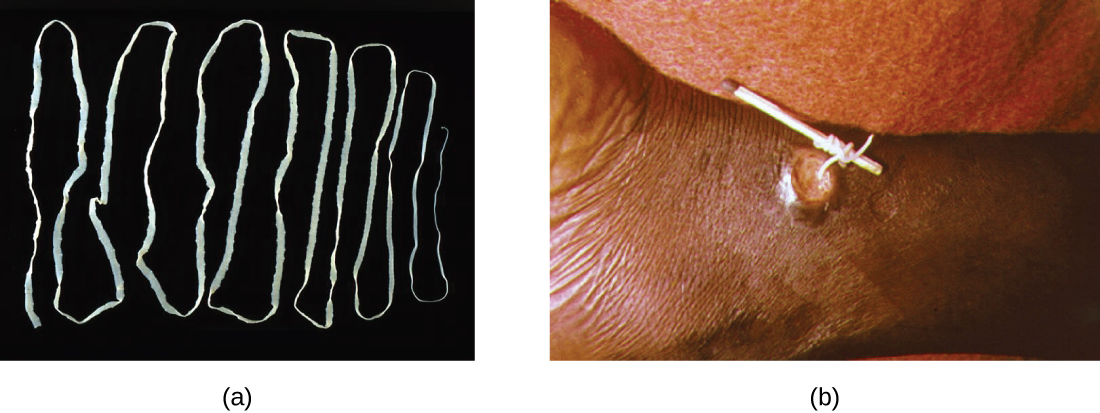
See Figure 12.18 for images of a tapeworm and a guinea worm.[1] Of the many species that exist in these groups, about half are parasitic and some are important human pathogens.
Indications:
Anthelmintic medications target parasitic helminths.[2] There are many drugs in this class including: albendazole, thiabendazole, mebendazole, ivermectin, praziquantel, diethylcarbamazine, pyrantel pamoate.
Mechanism of Action:
Because helminths are multicellular eukaryotes like humans, developing drugs with selective toxicity against them is extremely challenging. Despite this, several effective classes have been developed. Many anthelmintic medications work by preventing microtubule formation within the parasitic cell, compromising glucose uptake. Others work by blocking neuronal transmission within the parasite, subsequently causing starvation, paralysis, and death of the worms. Additionally, many anthelmints inhibit ATP formation and impair calcium uptake inducing paralysis and death of the worms.[3]
Nursing Considerations:
Anti-helminth medications have varying dosages and duration of action. Many are taken orally, and usually require 1-2 doses or doses over 1-3 days, although this varies depending on the medication and pathogen. Many of the medications cause paralysis of the parasite which is then expelled.
Prolonged therapy using anthelmintic medication can result in liver damage and bone marrow suppression.
Client Teaching:
- Clients on antihelmintic drug therapy should receive special instruction to ensure rigorous hygienic precautions to minimize the risk of reinfection.
- Wash all bedding, linens, towels, and clothing following treatment to minimize reinfection risk.[4]
Clinical Reasoning and Decision-Making Activity
Using the above information, consider the following clinical scenario question:
A mother reports that her four-year-old son had a worm in his stool this morning. They live on a dairy farm. She reports that her son enjoys being in the barn during chore time, and it is common for the livestock to develop “worms.” Mebendazole was prescribed. What client teaching should the nurse provide to the child and the mother?
Note: Answers to the Clinical Reasoning Activities and Critical Thinking questions can be found in the Chapter 12: Antimicrobial Medications answer key – Fundamentals of Nursing Pharmacology – 2nd Canadian Edition sections at the end of the book.
References
-
This work is a derivative of “Taenia saginata adult 5260 lores.jpg” and “Dracunculus medinensis.jpg” by Centers for Disease Control and Prevention is licensed under CC0 ↵
-
This work is a derivative of Microbiology by OpenStax licensed under CC BY 4.0. Access for free at https://openstax.org/books/microbiology/pages/1-introduction ↵
-
This work is a derivative of Microbiology by OpenStax licensed under CC BY 4.0. Access for free at https://openstax.org/books/microbiology/pages/1-introduction ↵
-
uCentral from Unbound Medicine. https://www.unboundmedicine.com/ucentral ↵